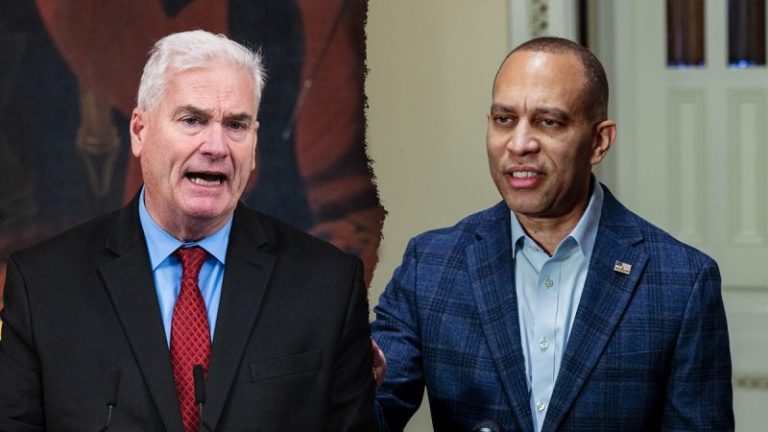
The No. 3 House Republican is accusing Democrats of making a hypocritical argument in their resistance to the GOP’s federal funding bill.
The government shutdown is in its thirteenth day with Republicans and Democrats still unable to agree on a path forward. The Trump administration is taking steps to prevent the military from missing paychecks this week, while also beginning to lay off scores of federal workers amid the standoff.
Democrats have said they will not agree to any solution that does not include serious concessions on healthcare from the GOP — but House Majority Whip Tom Emmer, R-Minn., argued that they are themselves harming healthcare access by allowing the shutdown to continue.
‘They are [jeopardizing healthcare],’ Emmer told Fox News Digital, pointing out that certain telehealth services, for example, are going without funding during the shutdown.
‘We had a huge advance during the pandemic when it came to remote care. You’ve got all kinds of constituents that don’t live in a condensed or a dense urban area right next to a hospital, right next to a provider, they may be a distance away. And the telehealth option actually made a big difference,’ Emmer said. ‘I know it did for our veterans.’
‘I don’t know if the VA — [House Veterans Affairs Committee Chairman Mike Bost, R-Ill.] made it sound like they’re going to protect that under his jurisdiction, not sure how — but I do worry about it for the private providers, hospitals. How are they going to do it if they’re not getting reimbursed?’
He was referring to the Acute Hospital Care At Home program, originally created during the COVID-19 pandemic. It allows healthcare providers to bill Medicare for telehealth appointments and at-home aid that previously was only reserved for hospital care.
It’s become a popular program for elderly or otherwise vulnerable Medicaid recipients, but the ongoing shutdown has prevented Congress from being able to extend it.
The government entered into a shutdown nearly two weeks ago on Oct. 1 after Senate Democrats rejected the GOP’s federal funding plan. They have since blocked consideration of the same bill six more times.
Republicans proposed a seven-week bill extending fiscal year (FY) 2025 federal funding levels through Nov. 21 called a continuing resolution (CR). It’s aimed at giving congressional negotiators more time to strike a longer-term agreement on FY2026, which began on Oct. 1.
It passed the House along mostly partisan lines on Sept. 19. But Democrats in the House and Senate were largely infuriated by being sidelined in federal funding talks and are now demanding any spending deal that also include an extension of COVID-19 pandemic-era enhanced Obamacare subsidies that are set to expire at the end of this year.
Democrats also introduced a separate counter-proposal that would completely eliminate healthcare reforms made in the GOP’s One Big Beautiful Bill Act (OBBBA) and restore funding to NPR and PBS that the Trump administration revoked earlier this year.
Democrats have said that proposal is aimed at rolling back Republicans’ Medicaid cuts. But Republicans have positioned it as the left’s effort at restoring federal funding for illegal immigrants’ healthcare — though Democratic leaders panned that as a lie.
Emmer also pointed out that it would revoke $50 billion for a rural hospital fund that OBBBA put in place.
‘The Rural Health Care Fund is a great example. I mean, right now, it’s our job, it’s the representatives’ job back in their districts, to try and work with our hospitals to make sure that they can access the funds,’ he said.
‘Because you don’t know exactly how deep the shutdown is going to impact hospitals, providers, ultimately consumers and patients.’
Westport Fuel Systems Inc. (‘Westport’) (TSX:WPRT Nasdaq: WPRT), a supplier of alternative fuel systems and components for the global transportation industry, announced today that Cespira, Westport’s joint venture with the Volvo Group, has signed an agreement with and received full payment from a leading OEM for Cespira’s HPDI TM components to be utilized in a customer truck trial.
Cespira will deliver several hundred sets of a key component in support of the trial. The truck trial is designed to assess the market interest and viability of the direct injection system in certain heavy-duty trucking markets and is expected to form the basis upon which the OEM will determine whether to make a further investment to commercialize this system. It is also important to note that some of the other system components not supplied by Cespira and used during the trial have not been validated by Cespira. Further information regarding the trial is not disclosed for commercially sensitive reasons.
About Westport Fuel Systems Westport is a technology and innovation company connecting synergistic technologies to power a cleaner tomorrow. As a leading supplier of affordable, alternative fuel, low-emissions transportation technologies, we design, manufacture, and supply advanced components and systems that enable the transition from traditional fuels to cleaner energy solutions.
Our proven technologies support a wide range of clean fuels – including natural gas, renewable natural gas, and hydrogen – empowering OEMs and commercial transportation industries to meet performance demands, regulatory requirements, and climate targets in a cost-effective way. With decades of expertise and a commitment to engineering excellence, Westport is helping our partners achieve sustainability goals—without compromising performance or cost-efficiency – making clean, scalable transport solutions a reality.
Westport Fuel Systems is headquartered in Vancouver, Canada. For more information, visit www.Westport.com.
Cautionary Note Regarding Forward Looking Statements This press release contains forward-looking statements, including statements regarding the joint venture (‘JV’) between Westport and the Volvo Group, the JV’s delivery of several hundred sets of a key component for the customer truck trial, the trial’s objective to assess market interest and viability of the direct injection system in the heavy-duty trucking sector, and the potential for further investment to commercialize the system, the performance and competitiveness of Westport’s products and Westport’s ability to help our partners achieve sustainability goals. These statements are neither promises nor guarantees, but involve known and unknown risks and uncertainties and are based on both the views of management and assumptions that may cause our actual results, levels of activity, performance or achievements to be materially different from any future results, levels of activities, performance or achievements expressed in or implied by these forward-looking statements. These risks, uncertainties and assumptions include, but are not limited to, those related to the delivery and performance of the JV system during the trial, the market’s response to the system, the unvalidated nature of certain other system components not supplied by the JV, potential regulatory hurdles, customer demand, and other factors that could impact the heavy-duty truck sector or the JV’s operations, including the general economy, governmental policies and regulation, technology innovations, new environmental regulations, the acceptance of and shift to natural gas vehicles, the relaxation or waiver of fuel emission standards, the inability of fleets to access capital or government funding to purchase natural gas vehicles, the development of competing technologies, our ability to adequately develop and deploy our technology, the actions and determinations of our joint venture and development partners, as well as other risk factors and assumptions that may affect our actual results, performance or achievements or financial position discussed in our most recent Annual Information Form and other filings with securities regulators. Readers should not place undue reliance on any such forward-looking statements, which speak only as of the date they were made. We disclaim any obligation to publicly update or revise such statements to reflect any change in our expectations or in events, conditions or circumstances on which any such statements may be based, or that may affect the likelihood that actual results will differ from those set forth in these forward-looking statements except as required by National Instrument 51-102. The contents of any website, RSS feed or twitter account referenced in this press release are not incorporated by reference herein.
Contact Information Investor Relations Westport Fuel Systems T: +1 604-718-2046
Israeli Prime Minister Benjamin Netanyahu on Monday praised President Donald Trump as the ‘greatest friend’ Israel has ever had, as Hamas released the last 20 living hostages under the new peace deal.
‘No American president has ever done more for Israel,’ Netanyahu said. ‘It ain’t even close.’
He thanked Trump for ‘standing up for Israel’ at the United Nations, recognizing Israel’s rights in the West Bank — or the Judea and Samaria — and withdrawing from the ‘disastrous’ Iran nuclear deal.
‘Thank you for supporting Operation Rising Lion and for your bold decision to launch Operation Midnight Hammer,’ Netanyahu said, referring to the June strikes on Iran’s nuclear sites. ‘Boy, you got to hear this — this is the most fitting name ever given to a military operation, because a little after midnight, you really hammered them.’
Netanyahu announced that he has nominated Trump to be the first non-Israeli recipient of the Israel Prize, which he described as the nation’s ‘highest award.’
During his own speech, Trump said of Netanyahu with a smile, ‘He’s not easy — not the easiest guy to deal with — but that’s what makes him great.’
After Hamas terrorists attacked southern Israel on Oct. 7, 2023, killing more than 1,200 people and taking around 240 hostages, which resulted in two years of fighting in Gaza and left tens of thousands estimated dead, Israel and Hamas agreed to a breakthrough peace deal last week after months of mediation by Trump administration officials.
The prisoner exchange between Israel and Hamas began Monday, with Hamas releasing the final 20 living hostages in exchange for Israel freeing 2,000 Palestinian prisoners. The release was part of a sweeping 20-point peace plan aimed at ending the conflict and rebuilding Gaza. So far, only four of the 28 presumed dead hostages have been returned.
Under the agreement, Israel halted military operations and withdrew to pre-defined lines while preparations began for a complete hostage exchange. Hamas members who renounce violence will be granted amnesty or safe passage, while those who continue resistance will be excluded from Gaza’s future governance.
Humanitarian aid — including critical supplies, infrastructure repair, and medical support — will flow freely into Gaza under the supervision of the United Nations, the Red Crescent, and other neutral organizations.
Gaza’s governance will transition to a technocratic Palestinian committee overseen by an international ‘Board of Peace’ chaired by Trump, alongside former British Prime Minister Tony Blair and other global leaders. This body will manage Gaza’s redevelopment until a reformed Palestinian Authority is prepared to take control.
A Trump-led economic development plan will seek to attract international investment and transform Gaza into a ‘thriving modern miracle city,’ supported by a special economic zone with preferential trade terms. The plan promises that no residents will be forced to leave Gaza, emphasizing voluntary participation in rebuilding efforts.
Security arrangements include the creation of a U.S.-led International Stabilization Force (ISF) to train Palestinian police, secure borders, and oversee disarmament. Israel will not occupy or annex Gaza but will gradually withdraw as security milestones are met. Regional partners, including Egypt and Jordan, will help ensure compliance and prevent the resurgence of militant threats.
Thousands of U.S.-bound packages shipped by UPS are trapped at hubs across the country, unable to clear the maze of new customs requirements imposed by the Trump administration.
As packages flagged for customs issues pile up in UPS warehouses, the company told NBC News it has begun “disposing of” some shipments.
Frustrated UPS customers describe waiting for weeks and trying to make sense of scores of conflicting tracking updates from the world’s largest courier.
“I’ve never seen anything like this before,” Matthew Wasserbach, brokerage manager of Express Customs Clearance, said of the UPS backlog. “It’s totally unprecedented.”
Wasserbach’s New York City-based shipping services firm helps clients move shipments through customs. He said the company has seen a spike in inquiries for help with UPS customs clearance.
A Boeing 747 operated by UPS on the tarmac at Louisville International Airport in Kentucky during a winter storm on Feb. 3, 2022.Luke Sharrett / Bloomberg via Getty Images file
More than two dozen people who are waiting for their UPS packages explained the circumstances of their shipments to NBC News.
They described shipments of tea, telescopes, luxury glassware, musical instruments and more — some worth tens of thousands of dollars — all in limbo or perhaps gone.
Others have deep sentimental value: notebooks, diplomas and even engagement rings.
The frustration has exploded online, with customers sharing horror stories on Reddit of missing skin care products, art and collectibles.
They are confused and angry, and they want answers.
“It’s almost impossible to get through to anybody to figure out what is happening,” said Ashley Freberg, who said she is missing several boxes she shipped via UPS from England in September.
“Are my packages actually being destroyed or not?”
Freberg’s boxes of journals, records and books were shipped on Sept. 18, according to tracking documents she shared with NBC News.
Over the next two weeks, she received two separate notifications from UPS that her personal mementos had not cleared customs and as a result had been “disposed of” by UPS.
Then, on Oct. 1, a UPS tracking update appeared for her packages, saying they were on the way. The tracking updates Freberg showed NBC News for that shipment revealed it was the most recent update she had received.
UPS transport jets wait to be loaded with packages at UPS Worldport in Louisville, Ky., on April 27, 2021.Timothy D. Easley / AP file
While sentimental value is impossible to measure, other customers fear they will not be able to recover financially if their goods were destroyed.
Tea importer Lauren Purvis of Portland, Oregon, said five shipments from Japan, mostly containing matcha green tea and collectively worth more than $127,000, were all sent via UPS over the last few weeks and arrived at UPS’ international package processing hub in Louisville, Kentucky. Purvis has yet to receive any of the shipments, only a flurry of conflicting tracking updates from UPS.
A series of notifications for one shipment, which she shared with NBC News, said that the shipment had not cleared customs and that UPS had disposed of it.
But a subsequent tracking update said the shipment had cleared customs and was on the way.
“We know how to properly document and pay for our packages,” Purvis said. “There should be zero reason that a properly documented and paid-for package would be set to be disposed of.”
At least a half-dozen people described an emotional seesaw they were put through by weeks of contradictory UPS tracking updates about their shipments. The updates, they said, compounded the stress of not knowing what had really happened to their possessions.
A UPS Boeing 767 aircraft taxis at San Diego International Airport, in San Diego, Calif., August 15, 2025.Kevin Carter / Getty Images file
AJ, a Boston man who asked that NBC News use only his initials to protect his privacy, said he shipped a package from Japan via UPS on Sept. 12 including Japanese language books, a pillow and a backpack.
After it sat in Louisville for nearly two weeks, AJ got a tracking update on Sept. 26, one of several that he shared with NBC News. “We’re sorry, your package did not clear customs and has been removed from the UPS network. Per customs guidelines, it has been destroyed. Please contact the sender for more information,” it read.
UPS tracking updates for a package shipped from Japan to the United States.Obtained by NBC News
Three days later, on Sept. 29, he received another, and this one read: “On the Way. Import Scan, Louisville, KY, United States.” For a moment, it appeared as though AJ’s shipment might have been found.
But less than 24 hours after his hopes were raised, another tracking update arrived: “We’re sorry,” it began. It was the same notice that his package had “been destroyed” that he had received on the 26th.
Two minutes later, he got his final update: “Unable to Deliver. Package cannot clear due to customs delay or missing info. Attempt to contact sender made. Package has been disposed of.”
International shipping was thrown into chaos after the long-standing “de minimis” tariff exemption for low-value packages ended on Aug. 29.
Packages with values of $800 or less, which were previously allowed to enter the United States duty-free, are now subject to a range of tariffs and fees.
They include hundreds of country-specific rates, or President Donald Trump’s so-called reciprocal tariffs, as well as new levies on certain products and materials.
President Donald Trump holds a chart as he speaks about reciprocal tariffs at a ‘Make America Wealthy Again’ event at the White House on April 2.Brendan Smialowski / AFP – Getty Images file
The result is that international shipping to the United States today is far more complex and costly than it was even two months ago.
The sweeping changes have caught private individuals and veteran exporters alike in a customs conundrum.
It is difficult to know the exact number of the packages that are stuck in UPS customs purgatory. Shipping companies guard their delivery data closely.
UPS reported to investors that in 2023, its international service delivered around 3.2 million packages per day.
This week, the company told NBC News that it is clearing more than 90% of the packages it handles through customs on the first day.
The rest of the packages, or less than 10%, require more time to clear customs and need to be held until they do. That could easily mean that thousands of UPS packages every day are not clearing customs on their first try.
In a statement to NBC News, UPS said it is doing its best to get all packages to their destinations while abiding by the new customs requirements.
“Because of changes to U.S. import regulations, we are seeing many packages that are unable to clear customs due to missing or incomplete information about the shipment required for customs clearance,” it said.
UPS said it makes several attempts to get any missing information and clear delayed shipments, contacting shippers three times.
“In cases where we cannot obtain the necessary information to clear the package, there are two options,” it said.
“First, the package can be returned to the original shipper at their expense. Second, if the customer does not respond and the package cannot be cleared for delivery, disposing of the shipment is in compliance with U.S. customs regulations. We continue to work to bridge the gap of understanding tied to the new requirements and, as always, remain committed to serving our customers.”
A conveyor belt carries envelopes and small packages past UPS workers to their destinations at Worldport on Nov. 20, 2015.Patrick Semansky / AP, file
NBC News asked UPS precisely what it does with packages when it tells customers their shipments have been unable to clear customs and have been “disposed of.” It would not say.
On Sept. 27, a shipper in Stockholm received a formal notification from UPS that two packages her glassware company sent to the United States — which failed to clear customs — would be destroyed.
“We are sorry, but due to these circumstances and the perishable nature of the contents, we are now required to proceed with destruction of the shipment in accordance with regulatory guidelines,” UPS told Anni Cernea in an email she shared with NBC News.
The email continued, “There is no need to contact our call center for further information or to attempt to clear this shipment.”
Cernea said, “It’s just outrageous that they can dispose of products like this without approval from either the sender or recipient.”
From now on, Cernea said, she plans to ship her products via UPS rival FedEx.
Cernea’s decision to switch carriers hints at the worst-case scenario for UPS, which is that people could abandon the company. It is a potential crisis for the roughly $70 billion company.
The company’s stock price is already down more than 30% this year, which analysts attribute to a mix of tariffs, competition and shifting shopping habits.
As she awaits her missing journals and diplomas from England, Freberg is looking ahead to the biggest shipping months of the year.
“I can’t even imagine how bad the holidays are going to be, because that’s a time where loads of people are shipping stuff overseas,” she said.
“If it doesn’t get solved soon, I can only see it becoming an even bigger issue.”
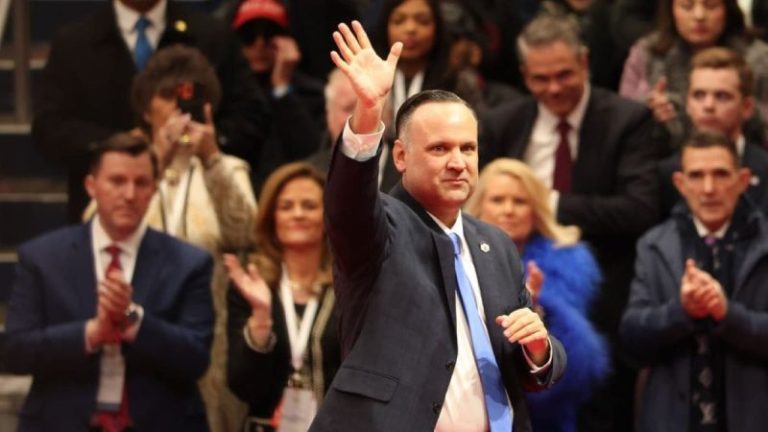
White House Deputy Chief of Staff Dan Scavino is poised to play an even larger role in President Donald Trump’s administration, the president announced Sunday.
Trump says Scavino, in addition to his current role, will now lead the White House Presidential Personnel Office. The office was previously held by Sergio Gor, who is now transitioning to become the U.S. Ambassador to India.
‘I am pleased to announce that the great Dan Scavino, in addition to remaining Deputy Chief of Staff of the Trump Administration, will head the White House Presidential Personnel Office, replacing Sergio Gor, who did a wonderful job in that position, and will now become the Ambassador to India,’ Trump wrote on Truth Social.
‘Dan will be responsible for the selection and appointment of almost all positions in government, a very big and important position. Congratulations Dan, you will do a fantastic job!’ he added.
Scavino’s new appointment comes as the Trump administration is in a pitched fight with Democrats to define the cause of the ongoing government shutdown.
Trump allies have pointed to Senate Minority Leader Chuck Schumer’s refusal to work with Republicans.
The president also sought to mitigate damage on Saturday by ordering War Secretary Pete Hegseth to make sure military service members get paid next week, regardless of the shutdown.
‘Chuck Schumer recently said, ‘Every day gets better’ during their Radical Left Shutdown,’ Trump wrote on Truth Social. ‘I DISAGREE! If nothing is done, because of ‘Leader’ Chuck Schumer and the Democrats, our Brave Troops will miss the paychecks they are rightfully due on October 15th.’
He said he directed Hegseth ‘to use all available funds to get our Troops PAID on October 15th. We have identified funds to do this, and Secretary Hegseth will use them to PAY OUR TROOPS.’
The government shut down on Oct. 1, after Democrats and Republicans failed to pass a spending bill to fund the government, with Democrats concerned expiring Affordable Care Act tax cuts could raise premiums and that Medicaid cuts could leave people without coverage.
NOT FOR DISTRIBUTION TO U.S. NEWS WIRE SERVICES OR FOR DISSMINATION IN THE UNITED STATES.
Saga Metals Corp. (‘SAGA’ or the ‘Company’) (TSXV: SAGA,OTC:SAGMF) (OTCQB: SAGMF) (FSE: 20H), a North American exploration company focused on critical minerals, is pleased to announce the closing of its previously announced non-brokered private placement pursuant to which the Company raised aggregate gross proceeds of C$2,988,024.64 (the ‘ Offering ‘).
Pursuant to the Offering, the Company issued (i) 7,100,088 flow-through common share units of the Company (the ‘ FT Units ‘) at C$0.28 per FT Unit for gross proceeds of C$1,988,024.64, and (ii) 4,000,000 hard dollar common share units of the Company (the ‘ HD Units ‘, and together with the FT Units, the ‘ Securities ‘) at C$0.25 per HD Unit for gross proceeds of C$1,000,000.
Financing Overview:
Each FT Unit consists of one flow-through common share as defined in subsection 66(15) of the Income Tax Act (Canada) (the ‘ Tax Act ‘), and one-half of one transferable common share purchase warrant (each whole warrant, a ‘ Warrant ‘). Each Warrant will entitle its holder to purchase one common share in the capital of the Company (a ‘ Warrant Share ‘) at a price of C$0.50 until October 10, 2027. The Warrant Shares underlying the FT Units will not qualify as ‘flow-through shares’ under the Tax Act.
Each HD Unit consists of one common share and one-half of one Warrant. Each whole Warrant will entitle its holder to purchase one Warrant Share at a price of C$0.50 until October 10, 2027.
Each of the Warrants will be subject to the right of the Company to accelerate the expiry date of the Warrants to a date that is 30 days following dissemination of a news release announcing such acceleration if, at any time, after October 10, 2025 (the ‘ Closing Date ‘), the closing price of the Company’s common shares equals or exceeds C$0.75 for a period of ten consecutive trading days on the TSX Venture Exchange (the ‘ Exchange ‘).
All securities issued in connection with the Offering are subject to a hold period of four months and one day following the Closing Date pursuant to applicable securities laws, expiring February 11, 2026.
The Company paid cash finder’s fees in the aggregate amount of $130,003 and issued an aggregate of 478,204 finder’s warrants in connection with the Offering. Each finder’s warrant entitles the holder thereof to purchase one common share of the Company at a price of $0.50 per share for a period of 24 months from the Closing Date.
The gross proceeds from the FT Units will be used by the Company for ‘Canadian exploration expenses’ that are ‘flow-through critical mineral mining expenditures’ (as such terms are defined in the Tax Act) on the Company’s Canadian mineral resource properties. The net proceeds of the HD Units will be used by the Company for administrative and general working capital, which may include investor relations activities.
The securities of SAGA have not been and will not be registered under the United States Securities Act of 1933, as amended (the ‘ U.S. Securities Act ‘), or any state securities laws, and may not be offered or sold, within the United States, unless exemptions from the registration requirements of the U.S. Securities Act and applicable state securities laws are available.
No securities regulatory authority has reviewed or approved of the contents of this news release. This news release does not constitute an offer to sell or a solicitation of an offer to buy any securities of SAGA in any jurisdiction in which such offer, solicitation or sale would be unlawful.
Marketing Services Agreement with Capitaliz.
The Company further reports that it has entered into a digital marketing services agreement effective as of October 13, 2025 (the ‘ Capitaliz Agreement ‘) with 1123963 B.C. Ltd. D.B.A. Capitaliz (‘ Capitaliz ‘). Pursuant to the Capitaliz Agreement, Capitaliz will, among other things, provide the Company with certain marketing services to expand investor awareness of the Company’s business and to communicate with the investment community (the ‘ Capitaliz Services ‘). The Capitaliz Services will be provided by Capitaliz over a three-month term. The Capitaliz Agreement may be terminated at any time by either party with 30 days’ notice.
Capitaliz is a content-driven digital marketing agency that connects public companies with social media influencers across all major social media platforms, leveraging a creator network that reaches over 100 million subscribers.
The Capitaliz Services will include, among other things: (i) multimedia content creation and syndication, including the production and distribution of editorial video content; (ii) targeted traffic generation through a combination of pay-per-click advertising, social media marketing, native advertising, search engine optimization, email campaigns, and retargeting strategies; and (iii) strategic social media amplification of campaign content across platforms such as Investorhub and YouTube; and (iv) expanded distribution through established relationships with financial media platforms. In consideration of the Capitaliz Services, and pursuant to the terms and conditions of the Capitaliz Agreement, the Company has agreed to pay Capitaliz a fee of C$200,000 (plus applicable taxes) over a three-month term, which will be paid using the Company’s available working capital.
The Capitaliz Services will be rendered primarily online through a variety of news and investment community communications channels. Jeff Leslie, the principal of Capitaliz – located at 704 – 595 Howe Street, Box 35, Vancouver, BC, V6C 2T5 – will be involved in conducting the Capitaliz Services. Capitaliz and Mr. Leslie do not have any interest, directly or indirectly, in the Company or its securities, or any right or intent to acquire such an interest. The terms and conditions of the Capitaliz Agreement remain subject to approval of the Exchange.
Online Marketing Agreement with i2i Marketing Group, LLC.
In addition, the Company reports that it entered into an online marketing agreement (the ‘ i2i Agreement ‘) with i2i Marketing Group, LLC (‘ i2i ‘). Pursuant to the i2i Agreement, i2i will, among other things, provide the Company with corporate marketing and investor awareness services, including, but not limited to, content creation management, author sourcing, project management and media distribution (the ‘ i2i Services ‘). The i2i Services will be provided by i2i pursuant to an initial US$250,000 budget, which will be paid using the Company’s available working capital, and may continue on a month-to-month basis thereafter until the i2i Agreement is terminated. The i2i Agreement may be terminated by either party upon 10 days’ advance written notice to the other party during the contract term.
The i2i Services will be rendered primarily online through a variety of news and investment community communications channels. Joe Grubb and Kailyn White, principals of i2i will be providing services on behalf of i2i, which has an office located at 1107 Key Plaza #222 Key West, FL 33040. i2i, Mr. Grubb, and Ms. White do not have any interest, directly or indirectly, in the Company or its securities, or any right or intent to acquire such an interest.
The terms and conditions of the i2i Agreement remain subject to approval of the Exchange.
About Saga Metals Corp.
Saga Metals Corp. is a North American mining company focused on the exploration and discovery of a diversified suite of critical minerals that support the global transition to green energy. The Radar Titanium Project comprises 24,175 hectares and entirely encloses the Dykes River intrusive complex, mapped at 160 km² on the surface near Cartwright, Labrador. Exploration to date, including a 2,200m drill program, has confirmed a large and mineralized layered mafic intrusion hosting vanadiferous titanomagnetite (VTM) with strong grades of titanium and vanadium.
The Double Mer Uranium Project, also in Labrador, covers 25,600 hectares featuring uranium radiometrics that highlight an 18km east-west trend, with a confirmed 14km section producing samples as high as 0.428% U 3 O 8 and uranium uranophane was identified in several areas of highest radiometric response (2024 Double Mer Technical Report).
Additionally, SAGA owns the Legacy Lithium Property in Quebec’s Eeyou Istchee James Bay region. This project, developed in partnership with Rio Tinto, has been expanded through the acquisition of the Amirault Lithium Project. Together, these properties cover 65,849 hectares and share significant geological continuity with other major players in the area, including Rio Tinto, Winsome Resources, Azimut Exploration, and Loyal Metals.
With a portfolio that spans key minerals crucial to the green energy transition, SAGA is strategically positioned to play an essential role in the clean energy future.
Neither the TSX Venture Exchange nor its Regulation Service Provider (as that term is defined in the policies of the TSX Venture Exchange) accepts responsibility for the adequacy or accuracy of this release.
Cautionary Disclaimer
This news release contains forward-looking statements within the meaning of applicable securities laws that are not historical facts. Forward-looking statements are often identified by terms such as ‘will’, ‘may’, ‘should’, ‘anticipates’, ‘expects’, ‘believes’, and similar expressions or the negative of these words or other comparable terminology. All statements other than statements of historical fact, included in this release are forward-looking statements that involve risks and uncertainties. In particular, this news release contains forward-looking statements regarding discussions of future plans, estimates and forecasts and statements as to management’s expectations and intentions with respect to, among other things, the Offering, including the expected use of proceeds from the Offering, the receipt of the Capitaliz Services and the i2i Services, and the terms of the Capitaliz Agreement and the i2i Agreement. There can be no assurance that such statements will prove to be accurate and actual results and future events could differ materially from those anticipated in such statements. Important factors that could cause actual results to differ materially from the Company’s expectations include, but are not limited to, changes in the state of equity and debt markets, fluctuations in commodity prices, delays in obtaining required regulatory or governmental approvals, environmental risks, limitations on insurance coverage, inherent risks and uncertainties involved in the mineral exploration and development industry, particularly given the early-stage nature of the Company’s assets, and the risks detailed in the Company’s continuous disclosure filings with securities regulations from time to time, available under its SEDAR+ profile at www.sedarplus.ca. The reader is cautioned that assumptions used in the preparation of any forward-looking information may prove to be incorrect. Events or circumstances may cause actual results to differ materially from those predicted, as a result of numerous known and unknown risks, uncertainties, and other factors, many of which are beyond the control of the Company. The reader is cautioned not to place undue reliance on any forward-looking information. Such information, although considered reasonable by management at the time of preparation, may prove to be incorrect and actual results may differ materially from those anticipated. Forward-looking statements contained in this news release are expressly qualified by this cautionary statement. The forward-looking statements contained in this news release are made as of the date of this news release and the Company will update or revise publicly any of the included forward-looking statements only as expressly required by applicable law.
HONG KONG — China outlined new curbs on exports of rare earths and related technologies on Thursday, extending controls over use of the elements critical for many high-tech and military products ahead of a meeting in about three weeks between President Donald Trump and Chinese leader Xi Jinping.
The regulations announced by the Ministry of Commerce require foreign companies to get special approval to export items that contain even small traces of rare earths elements sourced from China. These critical minerals are needed in a broad range of products, from jet engines, radar systems and electric vehicles to consumer electronics including laptops and phones.
Beijing will also impose permitting requirements on exports of technologies related to rare earths mining, smelting, recycling and magnet-making, it said.
China accounts for nearly 70% of the world’s rare earths mining. It also controls roughly 90% of global rare earths processing. Access to such materials is a key point of contention in trade talks between Washington and Beijing.
As Trump has raised tariffs on imports of many products from China, Beijing has doubled down on controls on the strategically vital minerals, raising concerns over potential shortages for manufacturers in the U.S. and elsewhere.
It was not immediately clear how China plans to enforce the new policies overseas.
During a cabinet meeting Thursday, Trump said he had yet to be briefed on the new rules but suggested that the U.S. could stop buying Chinese goods. “We import from China massive amounts,” Trump said. “Maybe we’ll have to stop doing that.”
Neha Mukherjee, a rare earths analyst at Benchmark Mineral Intelligence, called the new export controls “a strategic move by China that mirror some of Washington’s new chip export rules.
“Most rare earth magnet manufacturers in the U.S., Japan and elsewhere remain heavily dependent on rare earths from China, so these restrictions will force some difficult decisions — especially for any company involved in military uses of rare earths because most of those export licenses are expected to be denied, he said.
“The message is clear: if the U.S. and its allies want supply chain security, they must build independent value chains from mine to magnet,” Mukherjee said.
The new restrictions are to “better safeguard national security” and to stop uses in “sensitive fields such as the military” that stem from rare earths processed or sourced from China or from its related technologies, the Commerce Ministry said.
It said some unnamed “overseas bodies and individuals” had transferred rare earths elements and technologies from China abroad for military or other sensitive uses which caused “significant damage” to its national security.
The new curbs were announced just weeks ahead of an expected meeting between Trump and Chinese President Xi Jinping on the sidelines of the Asia-Pacific Economic Cooperation forum in South Korea, that begins at the end of this month.
“Rare earths will continue to be a key part of negotiations for Washington and Beijing,” George Chen, a partner at The Asia Group, said in an emailed comment. “Both sides want more stability but there will be still a lot of noises before the two leaders, President Trump and Xi, can make a final deal next year when they meet. Those noises are all negotiation tactics.”
These new restrictions will likely prompt additional government and private investments in developing a mine-to-magnet supply chain outside of China. Mukherjee said that $520 million of investments in the American rare earths industry were announced just in the second quarter with most of that coming from the government.
And there is some progress already being made with American magnet maker Noveon announcing an agreement with Lynas Rare Earths this week to secure a supply of rare earths outside of China from Lynas’ mine in Australia, and MP Materials preparing to begin producing magnets later this year at its new plant in Texas that uses rare earths from the only U.S. mine that it operates in California.
In July, the U.S. Defense Department agreed to invest $400 million in shares of the Las Vegas company, establish a floor for the price of key elements, and ensure that all of the magnets made at a new plant in the first 10 years are purchased.
An MP Materials spokesperson said China’s action “reinforces the need for forward-leaning U.S. industrial policy. Building resilient supply chains is a matter of economic and national security.”
Wade Senti, president of the U.S. permanent magnet company AML, said it’s time to innovate.
“The game of chess that China is playing underscores the importance of developing innovation that changes the game and puts the United States in leading position,” Senti said.
Nazak Nikakhtar, a former Commerce Department undersecretary, said the new restrictions are “a significant development and escalation” by extending controls to related technology and equipment and to sectors like chipmakers. “This should be a wake-up call to the U.S. government that we need to invest in and appropriate more to domestic capabilities. Both are critical to rebuild America’s rare earths industrial base,” she said.
In April, Chinese authorities imposed export curbs on seven rare earth elements shortly after Trump unveiled his steep tariffs on many trading partners including China.
While supplies remain uncertain, China approved some permits for rare earth exports in June and said it was speeding up its approval processes.
The government shutdown is poised to enter a third week, and Democrats still appear to be struggling in the search for a cohesive messaging strategy.
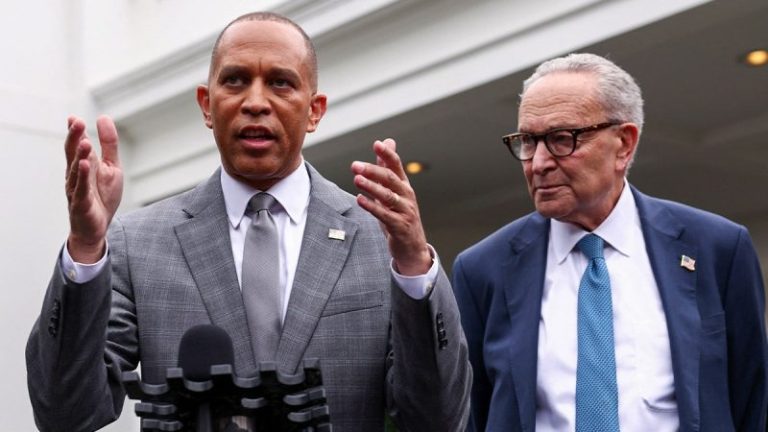
Senate Minority Leader Chuck Schumer, D-N.Y., received a barrage of GOP-led attacks on Thursday after he told Punchbowl News, ‘Every day gets better for us’ in reference to the shutdown dragging on.
Meanwhile, House Democrats’ group selfie taken on Sept. 29, just before the shutdown, received criticism from both sides of the aisle. Former Rep. Adam Kinzinger, R-Ill., who’s become a fierce critic of the GOP since leaving office, wrote on X, ‘These selfie things need to stop guys. Honestly, the democrats were great at social media but social media moved on from them. The kitschy, goofy ‘choose your fighter’ type stuff needs to stop.’
Democrats have been fighting to center the discussion on healthcare, and their argument that any deal to reopen the federal government must at least include an extension of COVID-19 pandemic-era enhanced Obamacare subsidies that are set to expire at the end of this year.
And while polls show that Americans overwhelmingly do support extending the subsidies, surveys taken of the government shutdown have been more mixed, with a significant number of Americans blaming both parties.
A new Reuters/Ipsos poll released on Wednesday showed 67% of Americans believe Republicans deserve ‘a fair amount or a great deal of blame’ for the shutdown, compared to 63% for Democrats.
A New York Times/Siena poll taken on the eve of the shutdown showed that Democrats had a similarly thin edge over the GOP in the shutdown fight, but that 65% of people did not believe Democrats should shut down the government if their demands were not met.
‘Democrats keep choosing the wrong fights, including the shutdown fight. At best, the shutdown will give them a political draw where the public will blame both parties,’ Julian Epstein, a former Democratic staffer for the House Judiciary Committee, told Fox News Digital.
‘But they will not get a game change out of this conflict, and the risk for them is the longer it goes on, the public will see it’s the Democrats who are narcissistically voting to shut down the government after losing the election.’
During an appearance on ‘Real Time With Bill Maher’ earlier this month, CNN political commentator and former Obama administration appointee Van Jones said Democrats ‘do the wrong thing at the wrong time for the right reason.’
Jones said he was in favor of extending the Obamacare subsidies but argued that it may have been folly for his party to pick that fight over the shutdown before people even got notice of their premiums potentially rising.
‘I get it, the base is upset … ’Please do something, do anything,’ but the ‘something’ probably shouldn’t be throwing a bunch of people out of work in the federal government and crushing the American government’s ability to function right before the pain was about to start,’ he said.
And it’s not yet clear if Democrats have an agreed-upon roadmap for how to navigate the shutdown yet.
Late last week, just before Speaker Mike Johnson, R-La., announced that the House would be out of session for another week while Republicans’ funding bill stalled in the Senate, House Minority Leader Hakeem Jeffries, D-N.Y., unequivocally told Fox News Digital that ‘yes,’ he would call all House Democrats back to Washington to draw a contrast between the two sides.
He walked that back somewhat on Monday, however. When asked by Fox News Digital if he would still call the full caucus back, Jeffries said, ‘We have a caucus meeting at 6 p.m. today. We’ll have a House Democratic Caucus leadership meeting, that’s the full leadership, tomorrow. And I expect a strong presence of House Democrats throughout here in Washington.’
What he did not specify, however, was that the 6 p.m. caucus meeting was virtual.
At another press conference this week, Jeffries called a one-year Obamacare subsidy extension compromise bill ‘laughable’ despite it getting support from 11 members of his own Democratic caucus.
He walked those comments back again, ‘If anything is presented to us, of course, the caucus will consider it in good faith.’
But Republicans have also garnered their share of public criticism for shutdown messaging as well.
President Donald Trump’s aggressive rhetoric on federal employee layoffs put congressional Republicans in a difficult position earlier this month, though Trump has since softened his language and not yet carried out those firings.
The White House’s depiction of Jeffries in a sombrero on multiple occasions has also been panned as racist by critics.
Mike Nellis, a Democratic strategist and founder of campaign consulting firm Authentic, said Democrats were doing the right thing in focusing on health care while criticizing Republicans’ messaging.
‘I think that focusing on the health care subsidies, which are undeniably popular, has been a really smart thing for Democrats to do,’ Nellis told Fox News Digital.
‘I think that the Republicans have played right into their worst tendencies on this, which is, much of their messaging is aggressively online-focused. The sombrero stuff is mildly funny. But then they went all in on it, and they don’t have a good answer to the health care subsidies.’
Nellis also argued that Republicans’ touting of a ‘landslide’ electoral victory has set them up for a larger share of the blame.
‘When you create the conditions where you talked about the mandate that you have and the government shuts down on your watch, you’re responsible for the government shutdown,’ he said.
Still, he said he would grade Democrats with a ‘B, B minus’ on their messaging, adding that it’s ‘not perfect.’
‘Maybe the answer is … Republicans are losing the shutdown fight, rather than Democrats are winning it,’ Nellis said. ‘But I mean, I just think we’ve got a lot more right than a lot more wrong, which is the first time you can say that in quite a while.’
Oil prices weakened in Q3 as global supply outpaced demand and inventories swelled.
Brent crude fell 1.7 percent to end the quarter at US$65.90 per barrel, while West Texas Intermediate dropped to US$62.33. Deloitte’s latest energy report attributes the decline to rising stockpiles and OPEC+’s early decision to unwind production cuts, adding 1.37 million barrels per day in October.
The US Energy Information Administration noted supply exceeded demand by 1.6 million barrels per day between May and August, pointing to continued stock builds ahead.
“OPEC+ discipline is still somewhat unpredictable — its production signals are becoming more tactical rather than structural,” Isaev wrote. “On the other hand, US shale is adjusting to price signals with a focus on capital restraint instead of just ramping up volume. LNG shipments to Europe and Japan are turning into geopolitical tools, not just simple commercial agreements.”
As for how that could affect energy stocks, he stated, ‘The advantage will go to those (companies) who can skillfully navigate this complexity, foresee critical turning points, and invest their capital with both accuracy and creativity.’
Despite the market volatility, the five top-performing oil and gas stocks on the TSX and TSXV have seen share price growth over Q3 2025. All year-to-date performance and share price data was obtained on October 9, 2025, using TradingView’s stock screener, and oil and gas companies with market caps above C$10 million at that time were considered.
Falcon Oil & Gas is an international oil and gas company specializing in the exploration and development of unconventional oil and gas assets, with interests in assets in Australia, South Africa and Hungary.
The company has a 22.5 percent interest in the Beetaloo joint venture, with Tamboran Resources (NYSE:TBN,ASX:TBN) owning the remainder.
On September 30, Falcon announced it entered into a definitive agreement to be wholly acquired by joint venture partner Tamboran. The combination will create a company with roughly 2.9 million net prospective acres across Australia’s Beetaloo Basin and a projected market cap of US$500 million.
The deal is expected to close in Q1 2026.
Falcon’s share price spiked to a year-to-date high of C$0.21 on October 1.
Calgary-based Imperial Oil is a prominent Canadian energy company involved in the exploration, production, refining and marketing of petroleum products. With a history spanning over 140 years, Imperial operates diverse assets across Canada, including oil sands, conventional crude oil and natural gas assets.
In early August, Imperial released its Q2 2025 results, reporting net income of C$949 million, down from C$1.29 billion in Q1, as weaker upstream realizations and downstream margin capture weighed on results.
Despite lower earnings, the company posted its strongest Q2 upstream production in over three decades, averaging 427,000 barrels of oil equivalent (boe/d), led by record output at Kearl. Refinery capacity utilization averaged 87 percent amid major turnaround work
During the quarter, Imperial also launched Canada’s largest renewable diesel facility, located in Alberta, and returned C$367 million to shareholders through dividends.
Shares of Imperial climbed through much of Q2 and Q3, and reached a year-to-date high of C$130.94 on September 16.
Athabasca Oil is focused on developing thermal and light oil assets within Alberta’s Western Canadian Sedimentary Basin. The company has established a substantial land base with high-quality resources. Its light oil operations are managed through its private subsidiary, Duvernay Energy, in which the company holds a 70 percent equity interest.
On July 24, Athabasca Oil reported its Q2 2025 results, highlighted by steady production and continued shareholder returns. The company produced an average of 39,088 boe/d, up 4 percent year-over-year. It generated C$127.6 million in adjusted funds flow during the quarter, down from C$165.75 in Q2 2024.
Capital spending totaled C$73 million, largely directed to expanding the company’s cornerstone Leismer project.
Additionally, Athabasca has repurchased 24 million shares year-to-date, reinforcing its “commitment to returning all thermal oil free cash flow to shareholders in 2025.” Its free cash flow from the segment totaled C$66 million in Q2.
A modest uptick in benchmark crude prices supported a stock bump for Athabasca Oil during the second week of October. Shares reached a year-to-date high of C$7.18 on October 8.
Headquartered in Calgary, Parex Resources is a Colombia-focused oil and gas producer with six oil-producing assets and one non-operational asset.
Parex’s Q2 results, released on July 30, highlighted an average output rate of 42,542 boe/d, with July production rising to 44,450 boe/d. The company said it is on track to meet its full-year guidance of 43,000 to 47,000 boe/d.
Parex also announced a third quarter dividend of C$0.385 per share.
‘As we enter the second half of the year, strong near-field exploration results in the Southern Llanos, combined with the ramp-up in development drilling, are expected to drive a steady step-up in production through year-end,’ the company stated.
On October 1, the company shared a production update, reporting it averaged 44,000 boe/d in Q3.
Shares of Parex climbed throughout the Q3 to a year-to-date high of C$19.68 on September 25.
MEG Energy is an energy company solely focused on in-situ thermal oil production in the southern Athabasca oil region of Alberta, Canada. Utilizing innovative enhanced oil recovery projects, including steam-assisted gravity drainage extraction methods, the company aims to increase oil recovery responsibly while reducing carbon emissions.
In May, Strathcona Resources (TSX:SCR) made an unsolicited C$4.1 billion offer for MEG, a move company executives at MEG quickly denounced. In a subsequent press release shared on June 16, MEG called the offer “inadequate, opportunistic, and NOT in the best interests of MEG or its shareholders.”
In mid-September MEG again urged shareholders to reject a revised offer from Strathcona and instead consider an August offer from Cenovus Energy (TSX:CVE).
On October 8, MEG announced that Cenovus increased its bid to C$8.6 billion, and again suggested shareholders accept the offer.
Following the increased bid, Shares of MEG rose to a year-to-date high of C$30.50 on October 9.
Securities Disclosure: I, Georgia Williams, hold no direct investment interest in any company mentioned in this article.