Author

admin

Browsing

Andy Schectman, president of Miles Franklin, weighs in on the factors moving gold and silver, emphasizing that their long-term drivers remain in place.

‘Nothing goes straight up without taking a breather, but you can still coexist. That can coexist with long-term bullishness, and I am hugely long-term bullish,’ he said.

Securities Disclosure: I, Charlotte McLeod, hold no direct investment interest in any company mentioned in this article.

This post appeared first on investingnews.com

The House of Representatives is expected to vote this week on whether to refer former President Bill Clinton and former Secretary of State Hillary Clinton to the Department of Justice (DOJ) for criminal charges.

The House Rules Committee, the final gatekeeper before most legislation gets a chamber-wide vote, is slated to consider a pair of contempt of Congress resolutions targeting the Clintons at 4 p.m. ET on Monday.

Those resolutions are expected to pass through the committee along party lines, teeing them up for final passage as early as Tuesday or Wednesday.

Both Clintons were subpoenaed to appear before the House Oversight Committee to testify for Congress’ probe into Jeffrey Epstein.

Despite months of back-and-forth between the former first couple’s lawyers and Oversight staff, they never appeared on terms dictated by Committee Chairman James Comer, R-Ky., pushing him to initiate contempt proceedings.

‘This shows that no one is above the law,’ Comer told reporters after his panel advanced the resolutions last month. ‘I’m just real proud of the committee and look forward to hopefully getting the Epstein documents in very quickly and trying to get answers for the American people.’

The committee voted along bipartisan lines to move forward with contempt resolutions against the Clintons. Nine Democrats joined the Republicans to advance the resolution against Bill Clinton, while three voted to advance Hillary Clinton’s.

The majority of Democrats, however, have accused Comer of partisan motivations behind his Clinton contempt efforts.

The Clintons were two of 10 people subpoenaed by Comer as part of the panel’s investigation into Epstein. The subpoenas were issued following a bipartisan vote by an Oversight subcommittee panel during an unrelated hearing on illegal immigration.

Democrats on the committee have pointed out that Comer has not pushed to hold others who did not appear in contempt, nor has he made any threats against the DOJ for failing to produce all of its documents on Epstein by a deadline agreed to by Congress late last year. The department has produced a fraction of the documents expected so far.

Comer has said he is in contact with the DOJ about its document production.

If the vote this week is successful, the House will have recommended both the Clintons for prosecution by the DOJ.

A contempt of Congress charge is a felony misdemeanor that carries a maximum fine of $100,000 and up to a year in jail.

This post appeared first on FOX NEWS

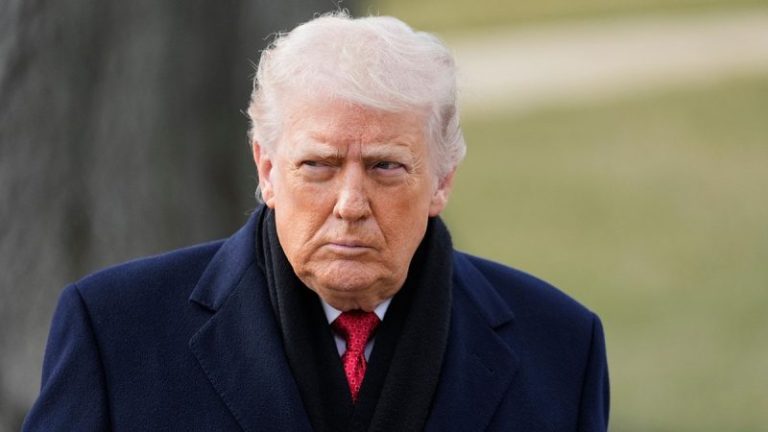
President Donald Trump said Saturday he believes Iran is negotiating ‘seriously’ with the U.S., stressing that he hopes an ‘acceptable’ deal can be brokered.

The president’s comments were made as he reportedly weighs options on a possible military strike on Iran amid widespread protests and a violent crackdown in the country.

When asked by a reporter aboard Air Force One whether he had decided on a strike against Iran, Trump responded, ‘I certainly can’t tell you that.’

‘But we do have very big, powerful ships heading in that direction,’ he added. ‘I hope they negotiate something that’s acceptable.’

The president then sidestepped a question about whether Tehran would be emboldened if the U.S. opted not to launch strikes on Iran, saying, ‘Some people think that. Some people don’t.’

‘You could make a negotiated deal that would be satisfactory with no nuclear weapons,’ Trump said. ‘They should do that, but I don’t know that they will. But they are talking to us. Seriously talking to us.’

Trump has said the U.S. will not share military plans with Gulf allies while negotiating with Iran, even as U.S. naval forces surge into the region.

Speaking with Fox News Channel senior White House correspondent Jacqui Heinrich on Saturday, Trump said, ‘We can’t tell them the plan. If I told them the plan, it would be almost as bad as telling you the plan — it could be worse, actually.’

‘But, look, the plan is that [Iran is] talking to us, and we’ll see if we can do something,’ Trump continued. ‘Otherwise, we’ll see what happens. … We have a big fleet heading out there, bigger than we had — and still have, actually — in Venezuela.’

On Sunday, the speaker of Iran’s parliament said the Islamic Republic now considers all European Union militaries to be terrorist groups after the bloc declared the country’s paramilitary Islamic Revolutionary Guard Corps a terror group over its crackdown on nationwide protests.

Iran again invoked a 2019 law to declare other nations’ militaries terrorist groups following the United States’ designation of the Guard as a terror organization that year.

The announcement by Mohammad Bagher Qalibaf, a former Revolutionary Guard commander, comes as the Islamic Republic also planned live-fire military drills for Sunday and Monday in the strategic Strait of Hormuz, the narrow mouth of the Persian Gulf through which roughly one-fifth of the world’s oil trade passes.

The Associated Press contributed to this report.

This post appeared first on FOX NEWS

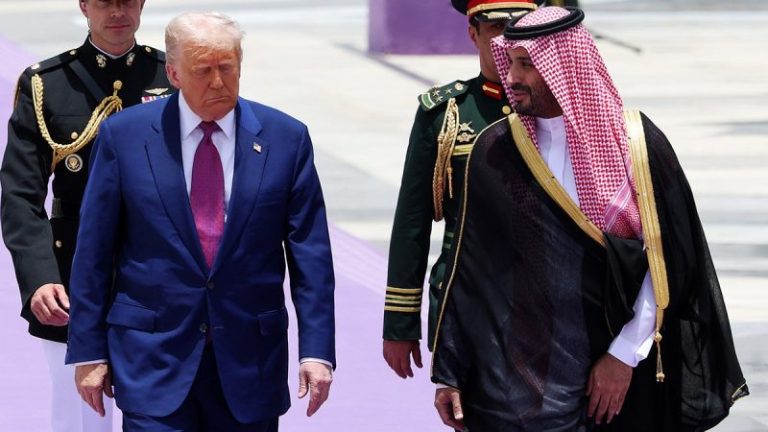
As President Donald Trump weighs his options on a possible military strike on Iran, a senior Gulf official told Fox News Saudi Arabia will not allow the U.S. to use its airspace or bases for such an attack.

A high-ranking government figure from a Gulf Cooperation Council (GCC) state told Fox News that the ‘U.S. hasn’t shared objectives or plans’ regarding Iran with Gulf allies despite recent high-level Saudi meetings in Washington aimed at gaining clarity.

‘We said this as friends, [we] want to make sure they understand our position and our assessment in general. And we want to understand the U.S. assessment with as much clarity as possible,’ the senior official said. ‘I’d like to get full clarity, and we did not get there.’

Regarding U.S. military movements for a strike on Iran, the official said, ‘The plan is something other than using Saudi airspace.’

The official said the U.S. is welcome in Saudi Arabia, especially regarding Operation Inherent Resolve, the ongoing U.S.-led campaign against ISIS. Yet, the Saudi position now is ‘consistent’ with what it was during the 12-day conflict between Israel and Iran in April 2024, the official said.

‘Saudi Arabia wouldn’t allow airspace to be used to target Israel, Houthis, Iran. The position is the same now. Saudi Arabia wouldn’t allow airspace to be used in a war Saudi Arabia is not a part of,’ the official said.

Trump said Friday that the United States has directly communicated expectations to Iran as pressure mounts for Tehran to accept a nuclear deal, even as Iranian officials publicly signal interest in talks.

Asked whether Iran faces a deadline to make a deal, Trump suggested the timeline had been conveyed privately. 

‘Only they know for sure,’ he said when pressed that the message had been delivered directly to Iranian leaders.

Trump also tied the growing U.S. naval presence in the region explicitly to Iran, saying American warships ‘have to float someplace’ and ‘might as well float near Iran’ as Washington weighs its next steps.

Despite the president’s words that Iran wants to make a deal, the official cautioned that ‘Iran always wants to make a deal, but the question is what kind of deal? Is it acceptable to the U.S.?

‘We don’t see it coming together at this moment,’ the official said. ‘Everybody knows the U.S. is bringing capabilities to the region in general to deal not with whatever the plan is but whatever the ramification of the plan is.’

Regarding the success of future U.S. actions in Iran, the official said, ‘There is always a problem whether you make a decision or don’t. There’s a balance of … future in the Middle East. We advise the U.S. on a better outcome at the end, using all means, including diplomatic means, and advise Iranians too. … We understand that we’re all in this — the U.S., Iran and others — and we hope for better results.’

The official said that, in the Gulf allies’ assessment, the Trump administration’s strikes on Iran’s nuclear assets heavily degraded their capabilities so that they are ‘not in the same situation as before.’

That being said, they believe an ‘off ramp could be reached by Iranians doing the right thing.’

‘We want a prosperous country that supports their people. That’s what we think we should all be doing. Iran has real economic potential, energy. A lot of talent in Iran and especially abroad who live in other countries. … There’s a way to get out of it, and Iran could be a very constructive actor in the region and important actor in the region. I hope that they get there because the Iranian people deserve a lot.’ 

Though the U.S. has not shared its objectives or plans, the source said, ‘I hope that outcome is for a more stable Middle East, more prosperous.’

This post appeared first on FOX NEWS

Gold and silver are wrapping up a record-setting week once again.

Starting with gold, the yellow metal left market participants hanging last week after finishing just shy of US$5,000 per ounce. However, it made up for it in spades this week, breaking through that level and continuing on up to smash through US$5,500.

Silver was no slouch either. After hitting triple digits at the end of last week it moved even higher this week, spending time above US$121 per ounce.

Unfortunately, it didn’t take long for those questions to be answered.

Gold and silver prices dropped precipitously as the week drew to a close, with the yellow metal finishing Friday (January 30) just below US$4,900 and silver sitting at about the US$85 level.

What’s going on, and more importantly, what should investors do?

Let’s tackle what’s going on first. The broad consensus from the experts I spoke to at VRIC was that gold and silver prices continue to be driven by elements that have been in play for years, such as strong central bank gold buying and silver’s persistent deficit. But both metals have new factors contributing to their gains.

Adrian Day of Adrian Day Asset Management highlighted two points that have changed for gold, with the first being increasing global chaos. Here’s how he explained it:

Day also mentioned gold purchases from stablecoin issuer Tether as a new factor for gold:

On the silver side, the dynamics are undeniably complex, but Willem Middelkoop of the Commodity Discovery Fund summed it up like this:

So how should investors approach this environment? Personalization was a major theme among the people I spoke to at VRIC, with many emphasizing the importance of understanding why you own the assets in your portfolio and what circumstances would lead you to sell.

Here’s Lobo Tiggre of IndependentSpeculator.com on how that could look right now:

With that said, two key themes emerged when it comes to what experts are doing now.

The first is silver stocks. Multiple market watchers, including Rick Rule of Rule Investment Media, believe silver stocks are set to move higher now that the metal itself has broken out.

Rule said he sold 80 percent of his physical silver and used around half of the money to buy silver companies. This is why he did it:

The second place people are rotating to is oil and gas stocks. You may remember that I touched on this in last week’s video, and the theme strengthened at VRIC — Rick himself took 25 percent of the money he made selling physical silver and put it in oil and gas stocks.

While opinions differ on whether now is the exact right time to buy, I heard multiple times that senior dividend-paying oil and gas companies are a play to consider for those who have taken profits in the gold and silver sector and are looking for the next ‘buy low’ opportunity.

Securities Disclosure: I, Charlotte McLeod, hold no direct investment interest in any company mentioned in this article.

This post appeared first on investingnews.com

Co-Listing Expands U.S. Investor Access and Visibility in World’s Largest Aviation and Capital Markets

Syntholene Energy CORP (TSXV: ESAF,OTC:SYNTF) (OTCQB: SYNTF) (FSE: 3DD0) (‘Syntholene’ or the ‘Company’) announces that its common shares have been approved for quotation and have commenced trading on the OTCQB Venture Market in the United States under the trading symbol SYNTF. The OTCQB co-listing is intended to broaden the Company’s U.S. investor audience and increase visibility within the world’s largest aviation fuel, capital markets, and energy infrastructure ecosystem.

The OTCQB Venture Market, operated by OTC Markets Group Inc., is a recognized public market in the United States designed for early-stage and developing companies that meet verified reporting and compliance standards. The Company’s primary listing remains on the TSX Venture Exchange under the symbol ESAF.

‘Establishing a U.S. trading presence on the OTCQB is a strategically important step for Syntholene,’ stated Syntholene CEO Dan Sutton. ‘The United States represents the largest aviation market globally and a core center of capital formation for energy and infrastructure investment. Providing U.S. investors with direct access to our shares aligns our capital markets strategy with the jurisdictions driving both demand growth and project financing for synthetic fuels. We view this co-listing as a natural extension of our TSX Venture Exchange and Frankfurt listings, as well as an important foundation for long-term engagement with U.S. institutional, strategic, and retail investors.’

Syntholene believes the OTCQB quotation enhances the Company’s visibility and accessibility in the United States at a time when policy support for sustainable aviation fuel and synthetic fuels is accelerating. U.S. federal and state initiatives, including tax credits, grant programs, and offtake support mechanisms under the Inflation Reduction Act and related Department of Energy and Department of Transportation programs, are driving increased investment into next-generation fuel production infrastructure.

About Syntholene

Syntholene is actively commercializing its novel Hybrid Thermal Production System for low-cost clean fuel synthesis. The target output is ultrapure synthetic jet fuel, manufactured at 70% lower cost than the nearest competing technology today. The company’s mission is to deliver the world’s first truly high-performance, low-cost, and carbon-neutral synthetic fuel at an industrial scale, unlocking the potential to produce clean synthetic fuel at lower cost than fossil fuels, for the first time.

Syntholene’s power-to-liquid strategy harnesses thermal energy to power proprietary integrations of hydrogen production and fuel synthesis. Syntholene has secured 20MW of dedicated energy to support the Company’s upcoming demonstration facility and commercial scale-up.

Founded by experienced operators across advanced energy infrastructure, nuclear technology, low-emissions steel refining, process engineering, and capital markets, Syntholene aims to be the first team to deliver a scalable modular production platform for cost-competitive synthetic fuel, thus accelerating the commercialization of carbon-neutral eFuels across global markets.

For further information, please contact:
Dan Sutton, CEO
comms@syntholene.com 
www.syntholene.com
+1 608-305-4835

Investor Relations
KIN Communications Inc.
604-684-6730
ESAF@kincommunications.com

Neither TSX Venture Exchange nor its Regulation Services Provider (as that term is defined in policies of the TSX Venture Exchange) accepts responsibility for the adequacy or accuracy of this release.

Forward-Looking Statements
This press release contains forward-looking statements within the meaning of applicable securities laws. The use of any of the words ‘expect’, ‘anticipate’, ‘aims’, ‘continue’, ‘estimate’, ‘objective’, ‘may’, ‘will’, ‘project’, ‘should’, ‘believe’, ‘plans’, ‘intends’ and similar expressions are intended to identify forward-looking information or statements. All statements, other than statements of historical fact, including but not limited to statements regarding the development and intended benefits of the Company’s technology, commercial scalability, technical and economic viability, anticipated geothermal power availability, anticipated benefit of eFuel, and future commercial opportunities, are forward-looking statements.

The forward-looking statements and information are based on certain key expectations and assumptions made by the Company, including without limitation the assumption that the Company will be able to execute its business plan, that the eFuel will have its expected benefits, that there will be market adoption, and that the Company will be able to access financing as needed to fund its business plan. Although the Company believes that the expectations and assumptions on which such forward-looking statements and information are based are reasonable, undue reliance should not be placed on the forward-looking statements and information because the Company can give no assurance that they will prove to be correct. Since forward-looking statements and information address future events and conditions, by their very nature, they involve inherent risks and uncertainties.

Actual results could differ materially from those currently anticipated due to a number of factors and risks, including, without limitation, Syntholene’s ability to meet production targets, realize projected economic benefits, overcome technical challenges, secure financing, maintain regulatory compliance, manage geopolitical risks, and successfully negotiate definitive terms. Syntholene does not undertake any obligation to update or revise these forward-looking statements, except as required by applicable securities laws.

Readers are advised to exercise caution and not to place undue reliance on these forward-looking statements.

To view the source version of this press release, please visit https://www.newsfilecorp.com/release/282096

News Provided by TMX Newsfile via QuoteMedia

This post appeared first on investingnews.com

Last week, Secretary of War Pete Hegseth released the 2026 National Defense Strategy (NDS), a Pentagon blueprint that elevates Israel as a ‘model ally’ and translates President Trump’s national security doctrine into concrete military policy.

‘Israel has long demonstrated that it is both willing and able to defend itself with critical but limited support from the United States. Israel is a model ally, and we have an opportunity now to further empower it to defend itself and promote our shared interests, building on President Trump’s historic efforts to secure peace in the Middle East,’ the NDS states.

The document is now influencing parallel debates over the future of U.S. security assistance to Israel and whether the next Memorandum of Understanding, or MOU, should continue delivering traditional U.S. military aid to Israel, amid dissenting voices that portray the alliance as a burden rather than a strategic asset.

According to the strategy, Israel proved its ability and willingness to defend itself following the Oct. 7 attacks, demonstrating that it is not a passive partner but an operational force that supports U.S. interests in the region. The strategy emphasizes empowering capable allies rather than constraining them, building on President Trump’s earlier push for regional integration through the Abraham Accords.

Jonathan Ruhe, director of foreign policy at the Jewish Institute for National Security of America, said the strategy reflects a broader American shift toward partnerships that strengthen both U.S. security and domestic industry.

‘U.S. defense assistance to Israel in the MOU is spent in dollars here in America to support our industry,’ Ruhe told Fox News Digital. ‘And like in the national security strategy, it then enables Israel to go and do more to protect U.S. interests.’

He said a future agreement would likely extend beyond funding alone. ‘A new MOU would also likely be broader and include things that are more 50-50 partnership, like joint research and development, co-production, intelligence sharing and things like that to reflect the changing partnership going forward,’ Ruhe said.

The strategy also highlights the importance of revitalizing the American defense industrial base, noting that allies purchasing U.S. systems help strengthen domestic production while enabling partners to shoulder greater responsibility for regional security.

Avner Golov, vice president of the Israeli think tank Mind Israel, said the document makes clear that Israel is viewed not merely as a recipient of aid, ‘Israel is in the fight. We are protecting ourselves by ourselves. We just need the tools to do that. And by doing so, we enhance not only America’s standing in the Middle East, but also worldwide and contribute to the American economy.’

That framing comes as Israel and the United States prepare for negotiations over the next 10-year MOU, which governs U.S. military assistance to Israel. The current agreement, signed in 2016, provides $3.3 billion annually in foreign military financing, along with $500 million a year for missile defense cooperation.

The debate follows tensions during the Biden administration, when the White House paused the delivery of certain U.S. weapons to Israel in May 2024, including a shipment of 2,000-pound bombs. At the time, Netanyahu warned that Israel ‘will stand alone’ if Washington halted weapons deliveries, reflecting concern that limits or delays in U.S. military support could undermine Israel’s readiness and deterrence. 

Experts have noted that U.S. leaders have not always approved every Israeli weapons request and that roughly 70% of Israel’s military imports come from the United States, underscoring the strategic calculus behind Prime Minister Netanyahu’s recent push for greater independent production.

Golov criticized that approach, arguing it risks prioritizing optics over readiness. ‘I believe that is a short-term vision,’ Golov said. ‘In the long term, Israel must first be prepared for the next round of escalation. If we are not ready, we will face another war. If we are prepared, perhaps we can deter it.’

‘Israel must remain the strongest army in the region, and that is also a fundamental American interest,’ Golov said.

Ruhe said the debate reflects lessons learned from nearly two years of war. ‘You’ve got this sort of topsy-turvy world now where the Israelis are saying we don’t want to take any more U.S. money, and the Americans are saying, no, you’re going to take our money,’ he said.

According to Ruhe, the conflict exposed vulnerabilities created by heavy dependence on U.S. supply chains and political delays.

‘The war of the last two years showed that Israel can’t afford to be as dependent on the U.S. or continue to maintain the same defense partnership that it has because that creates a dependence,’ he said. ‘Israel becomes vulnerable to U.S. shortages in weapons output or politically motivated embargoes and holdups that can impact Israel’s readiness.’

At the same time, Ruhe noted that Israel remains reliant on the United States for major platforms.

‘Even Israel will say we’re utterly dependent on the U.S. for those big-ticket platforms,’ he said, pointing to aircraft such as the F-15 and F-35 that Israel has already committed to purchasing.

For that reason, Ruhe argued that maintaining stable funding under the next MOU may be the most practical path forward.

‘It’s actually much easier for Congress just to go ahead and approve that money,’ he said, explaining that predictable funding reduces annual political battles on Capitol Hill.

Golov said Israel’s long-term objective should not be reducing ties with Washington, but deepening them. ‘I don’t want to reduce dependency,’ he said. ‘I want to increase contribution to America.’

He described the emerging vision as a fundamental shift in how the alliance is structured. ‘We are moving from a 20th-century aid model to a 21st-century strategic merger,’ Golov said. ‘Israel is the only partner that delivers a 400% return on investment without asking for a single American soldier.’

Golov said the proposed framework is built around three pillars: an industrial defense ecosystem, a joint technology ecosystem and a regional ecosystem connecting Israeli innovation, Gulf infrastructure and American power.

He emphasized that maintaining U.S. security assistance during the transition period is critical.

‘We need a final ten-year ‘bridge’ with the current security aid MOU,’ Golov said. ‘A sudden cut would be a dangerous signal of American retreat to our enemies and may hinder IDF preparedness.’

‘I don’t know who the next president of the United States will be,’ he added. ‘This is where our enemies can read it in a very dangerous way.’

This post appeared first on FOX NEWS

Amazon said Wednesday it was slashing another 16,000 jobs across the company in an ongoing bid to restructure the sprawling trillion-dollar firm.

‘The reductions we are making today will impact approximately 16,000 roles across Amazon, and we’re again working hard to support everyone whose role is impacted,’ Beth Galetti, Amazon’s senior vice president of people experience and technology, said in a memo to employees.

‘That starts with offering most US-based employees 90 days to look for a new role internally,’ she said. Amazon will ‘continue hiring and investing in strategic areas and functions that are critical to our future.’

Galetti said the cuts would ‘strengthen our organization by reducing layers, increasing ownership, and removing bureaucracy.’

In October, Amazon cut 14,000 jobs primarily at the corporate level. At the time, Galetti cited artificial intelligence as being the “most transformative technology we’ve seen since the internet.”

Amazon has 1.55 million employees worldwide, the company said in a filing last year.

It said Tuesday that it would close some of its Amazon Go and Amazon Fresh physical stores, planning to convert some into Whole Foods Market stores.

While AI was not explicitly cited in Wednesday’s note to Amazon workers, the cuts come as workers nationwide brace for the impact of artificial intelligence in a sluggish labor market.

Companies have started citing ‘efficiency’ as they pursue the implementation of AI.

On Monday, Goldman Sachs CEO David Solomon said that his firm’s headcount would be ‘more constrained in 2026’ as the company sees ‘opportunities for efficiency and we try to deploy those.’

On Tuesday, Pinterest said it would cut 15% of its workforce as it pivoted ‘resources to AI-focused roles and teams that drive AI adoption and execution.’

Last year, Microsoft said it was eliminating 9,000 jobs to improve efficiency. Target also cut 1,800 corporate jobs to reduce ‘complexity.’ Instagram and Facebook owner Meta Platforms also reduced its workforce by around 600 jobs as it shifted toward artificial intelligence.

At the same time, hiring nationwide is slowing and inflation remains elevated.

After three months of contraction last year, the U.S. economy added only 56,000 jobs in November and just 50,000 in December. Meanwhile, inflation remains at 2.7%, well above the Federal Reserve’s target of 2%.

This post appeared first on NBC NEWS

Blackrock Silver Corp. (TSXV: BRC,OTC:BKRRF) (OTCQX: BKRRF) (FSE: AHZ0) (the ‘Company’ or ‘Blackrock’) is pleased to announce the appointment of Sean Thompson as Head of Investor Relations for the Company.

Mr. Thompson is a seasoned capital markets professional with over 17 years of experience in the metals and mining sector. He has a proven track record of driving shareholder value through strategic communications and stakeholder relationship management, particularly for high-growth, development-stage companies.

Prior to joining Blackrock, Mr. Thompson held senior Investor Relations roles at several highly successful precious metals developers that were ultimately acquired in significant M&A transactions: Atlantic Gold Corp.: acquired for C$722 million and Kaminak Gold Corp.: acquired for C$520 million.

His excellence in the field has been recognized by the broader investment community. Mr. Thompson was awarded ‘Best IR by a TSX Venture listed Company’ at the IR Magazine Awards Canada 2018 and received a nomination for the same award in 2016.

Most recently, Mr. Thompson served as Vice President, Corporate Development & Investor Relations at Westhaven Gold Corp. During his tenure, he was a key member of the leadership team that successfully transitioned the company from a grassroots discovery through to a positive Preliminary Economic Assessment (PEA).

Andrew Pollard, Blackrock’s President and Chief Executive Officer, commented: ‘With an updated preliminary economic assessment in view, a robust treasury, and permitting initiatives well-underway, Sean is joining the Company at a pivotal time as we seek to broaden our market profile. Sean brings an impressive track-record in broadening investor bases with other highly-followed precious metals developers, and we’re excited to welcome him to the team as we position ourselves as the next American silver developer.’

Mr. Thompson holds an MBA from Dalhousie University, providing him with the analytical depth required to help manage and communicate financial modeling and peer-group valuations across the gold and silver sectors.

In connection with Mr. Thompson’s appointment, the Company has granted him 200,000 stock options of the Company (‘Stock Options‘) pursuant to the Company’s Omnibus Equity Incentive Compensation Plan. Each Stock Option entitles him to purchase one (1) common share of the Company (each, a ‘Common Share‘) at an exercise price per Common Share of $1.53 and will vest as to one-third on each of the first, second and third anniversaries of the date of grant, expiring on January 29, 2031.

About Blackrock Silver Corp.

Backed by gold and silver ounces in the ground, Blackrock is a junior precious metal focused exploration and development company driven to add shareholder value. Anchored by a seasoned Board of Directors, the Company is focused on its 100% controlled Nevada portfolio of properties consisting of low-sulphidation, epithermal gold and silver mineralization located along the established Northern Nevada Rift in north-central Nevada and the Walker Lane trend in western Nevada.

Additional information on Blackrock Silver Corp. can be found on its website at www.blackrocksilver.com and by reviewing its profile on SEDAR+ at www.sedarplus.ca.

Cautionary Note Regarding Forward-Looking Statements and Information

This news release contains ‘forward-looking statements’ and ‘forward-looking information’ (collectively, ‘forward-looking statements‘) within the meaning of Canadian and United States securities legislation, including the United States Private Securities Litigation Reform Act of 1995. All statements, other than statements of historical fact, are forward-looking statements. Forward-looking statements in this news release relate to, among other things: the advancement of the Tonopah West project towards development, including permitting and de-risking initiatives at the Tonopah West project; the intention to complete an updated Preliminary Economic Assessment on the Tonopah West project and the timing of completion thereof; the Company’s intentions to broaden its market profile; and the Company’s positioning as an American silver developer.

These forward-looking statements reflect the Company’s current views with respect to future events and are necessarily based upon a number of assumptions that, while considered reasonable by the Company, are inherently subject to significant operational, business, economic and regulatory uncertainties and contingencies. These assumptions include, among other things: conditions in general economic and financial markets; accuracy of assay results; geological interpretations from drilling results, timing and amount of capital expenditures; performance of available laboratory and other related services; future operating costs; the historical basis for current estimates of potential quantities and grades of target zones; the availability of skilled labour and no labour related disruptions at any of the Company’s operations; no unplanned delays or interruptions in scheduled activities; all necessary permits, licenses and regulatory approvals for operations are received in a timely manner; the ability to secure and maintain title and ownership to properties and the surface rights necessary for operations; and the Company’s ability to comply with environmental, health and safety laws. The foregoing list of assumptions is not exhaustive.

The Company cautions the reader that forward-looking statements involve known and unknown risks, uncertainties and other factors that may cause actual results and developments to differ materially from those expressed or implied by such forward-looking statements contained in this news release and the Company has made assumptions and estimates based on or related to many of these factors. Such factors include, without limitation: the timing and content of work programs; results of exploration activities and development of mineral properties; the interpretation and uncertainties of drilling results and other geological data; receipt, maintenance and security of permits and mineral property titles; environmental and other regulatory risks; project costs overruns or unanticipated costs and expenses; availability of funds; failure to delineate potential quantities and grades of the target zones based on historical data; general market, political, economic and industry conditions; and those factors identified under the caption ‘Risks Factors’ in the Company’s most recent Annual Information Form.

Forward-looking statements are based on the expectations and opinions of the Company’s management on the date the statements are made. The assumptions used in the preparation of such statements, although considered reasonable at the time of preparation, may prove to be imprecise and, as such, readers are cautioned not to place undue reliance on these forward-looking statements, which speak only as of the date the statements were made. The Company undertakes no obligation to update or revise any forward-looking statements included in this news release if these beliefs, estimates and opinions or other circumstances should change, except as otherwise required by applicable law.

For further information, please contact:

Andrew Pollard, President & Chief Executive Officer
Blackrock Silver Corp.
Phone: 604 817-6044
Email: andrew@blackrocksilver.com

Neither TSX Venture Exchange nor its Regulation Services Provider (as that term is defined in policies of the TSX Venture Exchange) accepts responsibility for the adequacy or accuracy of this release.

To view the source version of this press release, please visit https://www.newsfilecorp.com/release/281989

News Provided by TMX Newsfile via QuoteMedia

This post appeared first on investingnews.com

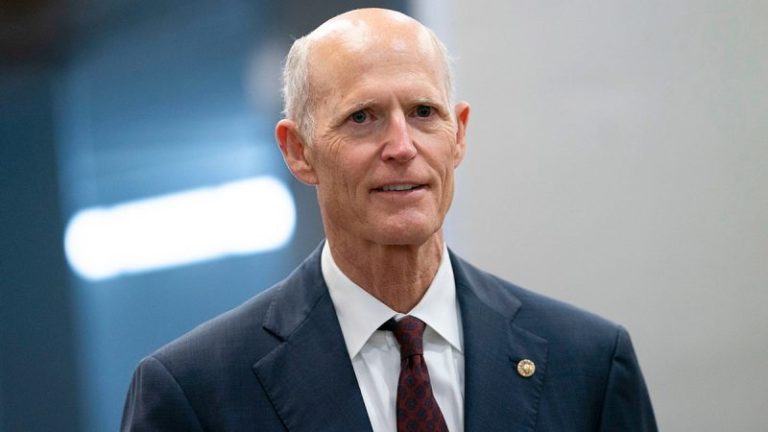
A former staffer for Sen. Rick Scott, R-Fla., is launching his own congressional bid on Thursday, Fox News Digital has learned.

Republican Austin Rogers is formally jumping into the race for Florida’s 2nd Congressional District, a solidly Republican seat encompassing part of the Sunshine State’s panhandle. It’s currently being represented by Rep. Neal Dunn, R-Fla., who is retiring at the end of this year.

Rogers invoked both President Donald Trump and Scott in a statement announcing his candidacy in a testament to the district’s conservative lean.

‘As President Trump and Senator Scott have shown, strong leadership matters,’ Rogers said. ‘I was raised right here in the 2nd District, fishing these bays, hunting these woods, and competing on these fields. I was taught to love this country, respect hard work, and stand up for what’s right. I’ve seen firsthand how broken Washington is. Our nation needs more fighters who will fearlessly root out waste, fraud, and abuse in government.’

Rogers previously worked as general counsel for Scott’s Senate office, which he argued helped him learn ‘how Congress actually works.’

‘I have drafted legislation, conducted congressional hearings, and led investigations holding the left accountable,’ Rogers said.

Scott’s campaign team told Fox News Digital that he has no current plans to make an endorsement in the race, however.

Rogers’ statement notably did not mention Florida Gov. Ron DeSantis, another central Republican figure in the Sunshine State, despite the district including the capital city of Tallahassee.

Rogers, a father of two with a third child on the way, was born and raised in his district and moved back there with his wife after a brief stint in Washington, D.C.

Meanwhile, a crowded field is forming to replace Dunn, a surgeon and retired Army major who first won his seat in 2016. 

Three Republicans and three Democrats have already filed to run for the district, with Rogers becoming the fourth GOP hopeful in the race.

Among the GOP candidates in the race is Evan Power, Florida’s Republican Party state chairman, and Keith Gross, a businessman who previously mounted a long-shot bid against Scott in 2024.

Dunn is part of a record number of House lawmakers announcing their departures from the lower chamber in the 119th Congress. Twenty-eight Republicans and 21 Democrats have announced retirements between this year and last year, more than during any other congressional term.

This post appeared first on FOX NEWS