Kinetiko Energy (KKO:AU) has announced Kinetiko Commences Trading on North American OTC Market
Download the PDF here.
This post appeared first on investingnews.com

Kinetiko Energy (KKO:AU) has announced Kinetiko Commences Trading on North American OTC Market
Download the PDF here.
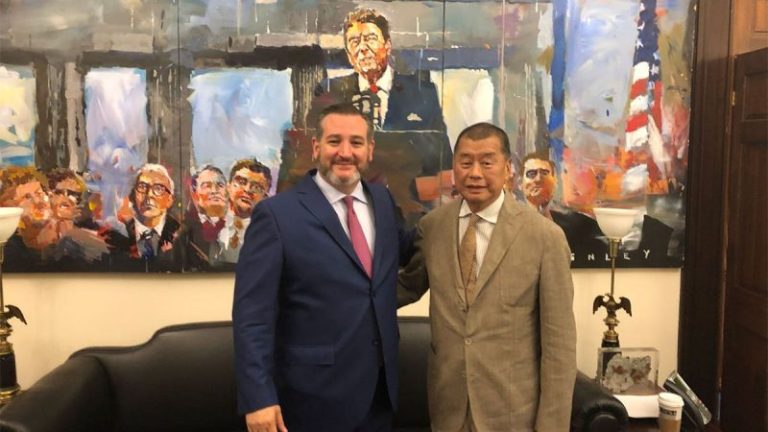
For Americans wondering about the future of China and its relationship with the West, the latest verdict in the Jimmy Lai case proves an ominous harbinger of Hong Kong’s continued slide towards authoritarianism. Lai, the self-made billionaire, media entrepreneur and pro-democracy activist, has been held prisoner of the Chinese Communist Party for five years under Hong Kong’s National Security Law. He was finally convicted Dec. 14 on trumped-up charges of sedition.
This verdict, handed down in 855 pages of meaningless gobbledygook, is Lai’s second conviction during his state-sponsored persecution since Hong Kong’s 2019 pro-democracy protests. Lai was previously found guilty of lease violations in connection with Apple Daily, his popular former newspaper that was closed by the Chinese government in 2021, and sentenced to 69 months in prison. The latest charges, for which Lai will be sentenced in early January, carry a penalty of 10 years to life in prison.
Of course, these nuances and timelines are meaningless; Lai has been imprisoned since December 2020, with his case delayed, extended, postponed, appealed and otherwise stage-managed in accordance with the wishes of the CCP. Lai was also denied the lawyers of his choice. Hong Kong will likely throw the book at him in January, and Lai – already in failing health due to the apparently inhumane conditions of his solitary confinement – will face eventual death in prison. It’s a grim birthday present for Lai, who turned 78 recently.
How did we get here? Lai knows why, describing himself as a ‘troublemaker, but one with a good conscience.’ ‘The establishment hates my guts,’ Lai says, and you’d have to say he’s earned that hatred from a leadership in Beijing and now Hong Kong that doesn’t tolerate dissent. Having participated in Hong Kong’s pro-democracy protests in 2019, supported the Umbrella Movement in 2014, and expressed public concern in the aftermath of 1989’s Tiananmen Square massacre, Lai has long been a thorn in the side of the CCP.
Lai’s irreverent, pro-free-speech publications, Apple Daily and Next Magazine, frequently reported unwelcome facts, challenged the status quo and asked hard questions of Chinese officialdom amid growing state censorship. It was Lai’s courageous, decades-long commitment to democratic values that led my organization, The Fund for American Studies, to honor him in 2022 with the Kenneth Y. Tomlinson Award for Courageous Journalism.
Among all his causes, Lai’s most dear was the protection of his adopted city, Hong Kong. Having escaped there as a child after growing up in 1950s mainland China, Lai knew firsthand that Communist regimes deprive their people of fundamental freedoms. Despite China’s treaty agreement with the U.K. and the CCP’s ‘one country, two systems’ commitment, which guaranteed Hong Kong’s autonomy until at least 2047, Lai foresaw that the CCP would accelerate its ultimate takeover of Hong Kong.
The mainland’s creeping authoritarianism is why my organization ended its program at the University of Hong Kong after 2019. We foresaw the coming crackdown in Hong Kong, and this week’s verdict is one more nail in the coffin of Hong Kong’s once internationally respected legal system. In a chilling coincidence, Hong Kong’s Democratic Party, the city’s largest opposition group, also voted to disband on the eve of the verdict. Unfortunately, our worries (and Lai’s) about Hong Kong’s future have been proven true.
Where do we go from here? First, Western leaders must continue to seek Lai’s release on humanitarian grounds. U.K. Prime Minister Keir Starmer plans to visit China next month, and his government has said that freeing Lai (who is a British citizen) is a priority. This week, President Donald Trump also asked Chinese leader Xi Jinping to free Lai. With Lai’s formal conviction now public, it may open up space for a diplomatic resolution. Now is the time to ramp up the pressure for his release.
Second, the West must remain vigilant in the face of China’s continued belligerence toward its neighbors and its suppression of values such as freedom of speech, religious liberty and press freedom. These are values under siege worldwide. Journalists, religious figures and democracy advocates have been killed or imprisoned for exercising these rights. Jimmy Lai is an example of incredible bravery and commitment to democratic values, but his imprisonment is also a sobering warning of the dangers of authoritarianism.
International Lithium Corp. (TSXV: ILC,OTC:ILHMF) (OTCQB: ILHMF) (FSE: IAH) (the ‘Company’ or ‘ILC’) will hold its 2025 Annual General Meeting today, December 22, at 9.30 a.m. Pacific Time. At that meeting, John Wisbey, Chairman and CEO, will make the following statement:
‘Good morning, and welcome to the 2025 Annual General Meeting of International Lithium Corp. (‘ILC’ or the ‘Company’). I would like to share a few comments on the year-to-date and the outlook ahead before proceeding with formalities.
‘In summary, 2025 has been a successful year for ILC, improved further by a major turnround in the lithium market from June onwards. The Company completed the sale of its Avalonia property in Ireland, and made a major advance in Southern Africa through obtaining an option to acquire an 80% interest in the company owning the important Karibib project in Namibia. It is important to note that ILC has become much more than a lithium company, and the expansion into other critical minerals will be especially notable if ILC exercises its option in Namibia. As well as lithium, the Karibib project contains the largest declared rubidium resource in Africa, and also enough cesium that, when refined, would meet a year of global demand. Rubidium and cesium are both valuable critical metals with multiple commercial uses.
‘The year for the lithium market has been one of two halves. In H1 2025, the lithium price, and that of related minerals such as spodumene, continued to be very weak, reaching a low in June of circa 10% of the 2023 highs. This, combined with the resultant impact on share prices, was painful for every company in the lithium sector, including ILC. However, in H2 2025, the position has seen a considerable improvement.
‘While much of the commodity market’s focus has been on gold, silver and platinum, the rebound in lithium prices has not been widely reported and has been largely overlooked. Yet in H2 2025, the spodumene price has risen by more than 100%, outperforming all precious metals. Most of that gain has come in Q4 2025. The main benchmark lithium carbonate price Li2CO3 has risen by around 65% from its June 2025 lows. If this trend continues, it will be very positive for the lithium sector.
‘The Company’s flagship Raleigh Lake project in Ontario, Canada is again, at today’s prices for spodumene, an economically viable project even if ILC were to focus solely on lithium. Moreover, it also carries a significant rubidium resource, and one of ILC’s goals in 2026 is to put a formal economic value on that rubidium resource, as we did in the PEA for lithium two years ago.
‘In September 2025, ILC announced that it had acquired an option to buy Lepidico’s 100% interest in Lepidico Mauritius for C$975,000. This brings with it an 80% interest in the Namibian company that owns 100% of the Karibib Lithium, Rubidium and Cesium project. As announced at the time, this is a major project that has received substantial investment and, indeed, reached the Definitive Feasibility Study stage under JORC in 2020. If the option is exercised, ILC will have a major stake in the largest declared rubidium resource in Africa and one of the largest in the world. There is also enough cesium at Karibib that, when refined, could meet a year of world demand. We are still waiting for the outcome of an arbitration case that Lepidico is engaged in and will decide whether or not to exercise the option shortly after receiving that result.
Lepidico’s 80% ownership of Karibib resulted from its 2019 acquisition of TSXV-listed Desert Lion Energy in exchange for shares and other securities valued at that time at AUD$ 22.9 million (approximately CAD$20.7 million). Since acquiring the company in 2019, Lepidico invested a further AUD$ 12.1 million (approximately CAD$ 10.9 million) in the Karibib project, excluding central group overheads, with a significant portion directed towards drilling, an environmental study and subsequently a Definitive Feasibility Study and a further Resource Estimate.
This project could become highly important to ILC in 2026, and the Company’s Southern Africa strategy will hopefully also be supplemented by progress on the announced Zimbabwe EPO applications.
‘The Company completed the sale of the Avalonia project in Ireland to a subsidiary of its partner, Ganfeng Lithium, whereby ILC also retains a 2% Net Smelter Royalty. The total of C$2.5m generated from this was used to advance the investment in the Namibian project and other ongoing initiatives.
Outlook
‘The good work done in 2025, and the upturn in the lithium market, gives a strong possibility of 2026 being a successful period for ILC. As well as extra work at the flagship Raleigh Lake project in Canada, if ILC exercises its option to buy Lepidico Mauritius, it will, at Karibib in Namibia, have a project that could otherwise have taken several years and tens of millions of dollars to bring a similar greenfield project to the same stage, let alone the time to identify such a project. Karibib would bring ILC not only lithium, but also a world-class resource in rubidium and one of the larger cesium deposits not controlled by a Chinese company.
‘Lithium and spodumene prices are now back up to the level where mine development is economically viable at Canadian prices. If their rise continues, this will be positive for ILC and the lithium industry overall. ILC’s additional focus on rubidium and cesium gives further strings to its bow that could turn ILC into a much larger company.
‘In closing, I would like to take this opportunity to wish all of our valued shareholders, advisors and other stakeholders a Merry Christmas and a happy, healthy and prosperous New Year.’
On behalf of the Company,
John Wisbey
Chairman and CEO
www.internationallithium.ca
For further information concerning this news release, please contact +1 604-449-6520 or info@internationallithium.ca or ILC@yellowjerseypr.com.
_______________________________________________________________________________________
Neither TSX Venture Exchange nor its Regulation Services Provider (as that term is defined in the policies of the TSX Venture Exchange) accepts responsibility for the adequacy or accuracy of this release.
Cautionary Statement Regarding Forward-Looking Information
Except for statements of historical fact, this news release or other releases contain certain ‘forward-looking information’ within the meaning of applicable securities law. Forward-looking information or forward-looking statements in this or other news releases may include: the timing of completion of any offering and the amount to be raised, the likelihood or otherwise of the Company exercising its option on Lepidico Mauritius, the outcome of arbitration involving Lepidico Namibia, the effect of results of anticipated production rates, the timing and/or anticipated results of drilling on the Karibib or Raleigh Lake or Firesteel or Wolf Ridge projects, the expectation of resource estimates, preliminary economic assessments, feasibility studies, lithium or rubidium or copper recoveries, modeling of capital and operating costs, results of studies utilizing various technologies at the company’s projects, the Company’s budgeted expenditures, future plans for expansion in Southern Africa and planned exploration work on its projects, increased value of shareholder investments in the Company, the potential from the Company’s third party earn-out or royalty arrangements, the future demand for lithium, rubidium, cesium and copper, and assumptions about ethical behaviour by our joint venture partners or third party operators of projects or royalty partners. Such forward-looking information is based on assumptions and subject to a variety of risks and uncertainties, including but not limited to those discussed in the sections entitled ‘Risks’ and ‘Forward-Looking Statements’ in the interim and annual Management’s Discussion and Analysis which are available at www.sedarplus.ca. While management believes that the assumptions made are reasonable, there can be no assurance that forward-looking statements will prove to be accurate. Should one or more of the risks, uncertainties or other factors materialize, or should underlying assumptions prove incorrect, actual results may vary materially from those described in forward-looking information. Forward-looking information herein, and all subsequent written and oral forward-looking information are based on expectations, estimates and opinions of management on the dates they are made that, while considered reasonable by the Company as of the time of such statements, are subject to significant business, economic, legislative, and competitive uncertainties and contingencies. These estimates and assumptions may prove to be incorrect and are expressly qualified in their entirety by this cautionary statement. Except as required by law, the Company assumes no obligation to update forward-looking information should circumstances or management’s estimates or opinions change.
To view the source version of this press release, please visit https://www.newsfilecorp.com/release/278761
News Provided by Newsfile via QuoteMedia

The Department of Homeland Security (DHS) is disputing reports that acting Cybersecurity and Infrastructure Security Agency (CISA) Director Madhu Gottumukkala failed a polygraph after seeking access to highly sensitive intelligence, as an internal investigation and the suspension of multiple career cybersecurity officials deepen turmoil inside the agency, according to a report.
Politico reported that Gottumukkala pushed for access to a tightly restricted intelligence program that required a counter-intelligence polygraph and that at least six career staffers were later placed on paid administrative leave for allegedly misleading leadership about the requirement, an assertion DHS strongly denies.
The outlet said its reporting was based on interviews with four former and eight current cybersecurity officials, including multiple Trump administration appointees who worked with Gottumukkala or had knowledge of the polygraph examination and the events that followed. All 12 were granted anonymity over concerns about retaliation, according to Politico.
DHS pushed back on the reporting, saying the polygraph at issue was not authorized and that disciplinary action against career staff complied with department policy.
‘Acting Director Madhu Gottumukkala did not fail a sanctioned polygraph test. An unsanctioned polygraph test was coordinated by staff, misleading incoming CISA leadership,’ DHS Assistant Secretary Tricia McLaughlin said in a statement provided to Fox News Digital. ‘The employees in question were placed on administrative leave, pending conclusion of an investigation.’
‘We expect and require the highest standards of performance from our employees and hold them directly accountable to uphold all policies and procedures,’ she continued. ‘Acting Director Gottumukkala has the complete and full support of the Secretary and is laser focused on returning the agency to its statutory mission.’
Politico also reported that Gottumukkala failed a polygraph during the final week of July, citing five current officials and one former official.
The test was administered to determine whether he would be eligible to review one of the most sensitive intelligence programs shared with CISA by another U.S. spy agency, according to the outlet.
That intelligence was part of a controlled access program with strict distribution limits, and the originating agency required any CISA personnel granted need-to-know access to first pass a counter-intelligence polygraph, according to four current officials and one former official cited by Politico.
As a civilian agency, most CISA employees do not require access to such highly classified material or a polygraph to be hired, though polygraphs are commonly used across the Pentagon and U.S. intelligence community to protect the government’s most sensitive information.
Politico reported that senior staff raised questions on at least two occasions about whether Gottumukkala needed access to the intelligence, but said he continued pressing for it even if it meant taking a polygraph, citing four current officials.
The outlet also reported that an initial access request in early June, signed by mid-level CISA staff, was denied by a senior agency official who determined there was no urgent need-to-know and noted that the agency’s previous deputy director had not viewed the program.
That senior official was later placed on administrative leave for unrelated reasons in late June, and a second access request signed by Gottumukkala was approved in early July after the official was no longer in the role, according to current officials cited by Politico.
Despite being advised that access to the most sensitive material was not essential to his job and that lower-classification alternatives were available, Gottumukkala continued to pursue access, officials told the outlet.
Officials interviewed by Politico said they could not definitively explain why Gottumukkala did not pass the July polygraph and cautioned that failures can occur for innocuous reasons such as anxiety or technical errors, noting that polygraph results are generally not admissible in U.S. courts.
On Aug. 1, shortly after the polygraph, at least six career staff involved in scheduling and approving the test were notified in letters from then–acting DHS Chief Security Officer Michael Boyajian that their access to classified national security information was being temporarily suspended for potentially misleading Gottumukkala, according to officials and a letter reviewed by Politico.
‘This action is being taken due to information received by this office that you may have participated in providing false information to the acting head of the Cybersecurity and Infrastructure Security Agency (CISA) regarding the existence of a requirement for a polygraph examination prior to accessing certain programs,’ the letter said. ‘The above allegation shows deliberate or negligent failure to follow policies that protect government information, which raises concerns regarding an individual’s trustworthiness, judgment, reliability or willingness and ability to safeguard classified information.’
In a separate letter dated Aug. 4, the suspended employees were informed by Acting CISA Chief Human Capital Officer Kevin Diana that they had been placed on paid administrative leave pending an investigation, according to current and former officials and a copy reviewed by Politico.
Gottumukkala was appointed CISA deputy director in May and previously served as commissioner and chief information officer for South Dakota’s Bureau of Information and Technology, which oversees statewide technology and cybersecurity initiatives.
CISA said in a May press release that Gottumukkala has more than two decades of experience in information technology and cybersecurity across the public and private sectors.

We also break down next week’s catalysts to watch to help you prepare for the week ahead.
US stocks advanced this week amid key economic data releases, with tech leading gains after Micron Technology’s (NASDAQ:MU) results release and easing artificial intelligence (AI) sector pressures.
The S&P 500 (INDEXSP:.INX) rose 0.02 percent on the week, closing Friday (December 19) at 6,834.5.
However, tech stock losses earlier in the week kept gains in check. The Nasdaq Composite (INDEXNASDAQ:.IXIC) lost 0.1 percent for the week to close at 23,307.62 on Friday.
Micron Technology reported earnings for its first fiscal quarter of 2026 on Thursday (December 18), showing strong results driven by surging high-bandwidth memory sales for AI data centers
Revenue reached US$13.64 billion, up 93 percent from last year and higher than the company’s September revenue projection of US$12.8 billion. Adjusted earnings per share were US$4.78, beating estimates of US$3.95. The company generated strong free cashflow and declared a US$0.115 per share dividend payable on January 14, 2026.
Looking ahead, Micron adjusted its profit guidance for the upcoming quarter to US$8.42 per share, higher than Wall Street’s US$4.78 consensus, due to continued AI boom momentum.
Investors responded to the results by sending Micron shares up 10 percent post-earnings. Momentum carried into Friday’s trading session, spilling over into other tech stocks, which have come under pressure in recent weeks over lofty valuations and funding concerns. The company ended the week 0.58 percent higher.
Trump Media & Technology Group rose nearly 30 percent before Thursday’s opening bell after the company announced plans to merge with fusion power company TAE Technologies.
The all-stock deal is reportedly valued at more than US$6 billion. Devin Nunes, chair and chief executive of Trump Media, and Dr. Michl Binderbauer, CEO and director at TAE, are set to serve as co-CEOs.
TAE is a private company with backing from Alphabet (NASDAQ:GOOGL) and other companies. The merger is slated to create one of the first publicly traded nuclear fusion companies. “We’re taking a big step forward toward a revolutionary technology that will cement America’s global energy dominance for generations,“ Nunes said.
Shares of Trump Media closed the week with a gain of 39.53 percent.
Oracle shares dropped 5.4 percent on Wednesday (December 17) after a Financial Times report claimed data center investor Blue Owl Capital pulled out of a US$10 billion financing round for one of the AI data centers Oracle is constructing for OpenAI in Michigan. Talks reportedly stalled due to concerns over project delays, tougher debt terms, Oracle’s rising debt load and lease arrangements, per sources cited by the news outlet.
Oracle disputed the report’s implications, stating that Michigan negotiations are “on schedule” without Blue Owl.
The company said its project development partner, Related Digital, has chosen “the best equity partner from a competitive group of options, which in this instance was not Blue Owl.” Still, the company finished the week with its share price ahead by 2.18 percent as tech stocks staged an end-of-year comeback.
Oracle, Micron Technology and Trump Media performance, December 15 to 19, 2025.
Chart via Google Finance.
Tech exchange-traded funds (ETFs) track baskets of major tech stocks, meaning their performance helps investors gauge the overall performance of the niches they cover.
This week, the iShares Semiconductor ETF (NASDAQ:SOXX) declined by 0.94 percent, while the Invesco PHLX Semiconductor ETF (NASDAQ:SOXQ) saw a loss of 0.66 percent.
The VanEck Semiconductor ETF (NASDAQ:SMH) also decreased by 0.61 percent.
Markets will be closed mid-week next week, with low trading volumes likely keeping movement calm.
Watch for year-end selling in tech stocks, a potential rotation into safer sectors and light data like factory orders and home sales reports. Any comments on future interest rates could move markets somehwat, but expect mostly flat trading unless big news like policy changes breaks through.
Securities Disclosure: I, Meagen Seatter, hold no direct investment interest in any company mentioned in this article.
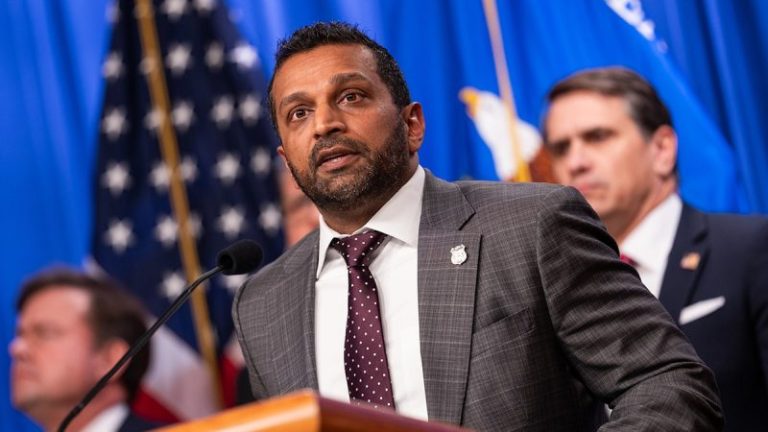
FBI Director Kash Patel said Saturday the agency is ramping up its use of artificial intelligence (AI) tools to counter domestic and international threats.
In a post on X, Patel said the FBI has been advancing its technology, calling AI a ‘key component’ of its strategy to respond to threats and stay ‘ahead of the game.’
‘FBI has been working on key technology advances to keep us ahead of the game and respond to an always changing threat environment both domestically and on the world stage,’ Patel wrote. ‘Artificial intelligence is a key component of this.
‘We’ve been working on an AI project to assist our investigators and analysts in the national security space — staying ahead of bad actors and adversaries who seek to do us harm.’
Patel added that FBI leadership has established a ‘technology working group’ led by outgoing Deputy Director Dan Bongino to ensure the agency’s tools ‘evolve with the mission.’
‘These are investments that will pay dividends for America’s national security for decades to come,’ Patel said.
A spokesperson for the FBI told Fox News Digital it had nothing further to add beyond Patel’s X post.
The FBI uses AI for tools such as vehicle recognition, voice-language identification, speech-to-text analysis and video analytics, according to the agency’s website.
Earlier this week, Bongino announced he would leave the bureau in January after speculation rose about his departure.
‘I will be leaving my position with the FBI in January,’ Bongino wrote in an X post Wednesday. ‘I want to thank President [Donald] Trump, AG [Pam] Bondi, and Director Patel for the opportunity to serve with purpose. Most importantly, I want to thank you, my fellow Americans, for the privilege to serve you. God bless America, and all those who defend Her.’

Trump Media & Technology will merge with a fusion power company in an all-stock deal that the companies said Thursday is valued at more than $6 billion.
Devin Nunes, the Republican congressman who resigned in 2021 to become the CEO of Trump Media, will be co-CEO of the new company with TAE Technologies CEO Michl Binderbauer.
Shares of Trump Media & Technology, the parent company of President Donald Trump’s Truth Social media platform, have tumbled 70% this year but jumped 20% before the opening bell Thursday.
TAE is a private company and the merger with Trump Media would create one of the first publicly traded nuclear fusion companies.
“We’re taking a big step forward toward a revolutionary technology that will cement America’s global energy dominance for generations,” Nunes said in a prepared statement.
TAE focuses on nuclear fusion, a technology that combines two light atomic nuclei to form a single heavier one. It releases enormous amount of energy, a process that occurs on the sun and other stars, according to the United Nation’s International Atomic Energy Agency.
TAE and Trump Media shareholders will each own approximately 50% of the combined company.
The companies say the transaction values each TAE common stock at $53.89 per share.
At closing, Trump Media & Technology Group will be the holding company for Truth Social and TAE, along with its subsidiaries TAE Power Solutions and TAE Life Sciences.

It’s not just Minnesota.
The past few weeks have made clear that fraudsters stole billions of dollars from states’ welfare programs, much of it from Medicaid. It also appears that Democratic politicians tolerated the heist for their own political benefit.
Yet politicians in virtually every state have let waste, fraud and abuse spread like wildfire in Medicaid, putting taxpayers on the hook for an estimated $2 trillion in improper spending over the next decade alone.
Thankfully, President Donald Trump and congressional Republicans have given states a reason to clean up this mess and spare taxpayers that pain.
In a new paper, I show how Democrats have turned Medicaid into one of the most fraud-ridden programs in America — and how Republicans are fixing it. While Medicaid has long been plagued with improper spending, Democrats supercharged this crisis in the Obama years.
ObamaCare added tens of millions of able-bodied adults to the program, yet that population is much more likely to be ineligible.
The Obama administration refused to rigorously check eligibility, and the Biden administration adopted the same policy, deliberately hiding an explosion in waste, fraud and abuse. Meanwhile, states refused to police their Medicaid programs, confident that the federal government would look the other way and cover the tab.
The first Trump administration found that 27.4% of federal Medicaid spending was improper in 2020, or about $120 billion at the time. The administration also found that four out of every five improper payments were the result of eligibility errors. This money flowed to people who shouldn’t have been on Medicaid and therefore diverted money and care away from its intended recipients. Five years later, it’s highly likely that at least one in five Medicaid dollars is still wrongly spent.
Call this what it is — an assault on taxpayers. It’s also a clear violation of federal law. States are legally required to reimburse the federal government for Washington’s share of Medicaid payments if their improper payment rates are above 3%, a far cry from the 27.4% rate in 2020.
The Trump administration is once again conducting eligibility checks, but even without that info, it’s all but certain that every state already exceeds the 3% threshold. The only reason they’ve avoided a budget blowout is by receiving so-called ‘good faith waivers’ from Washington. Essentially, states have promised that they’ll tackle fraud and abuse, even when they have no intention of doing so.
Republicans called time on this rigged game in the law President Trump signed July 4. They effectively eliminated good-faith waivers and told states that, starting in 2030, they will be forced to cover the federal share of any improper payments above 3%. While five years may seem like an eternity, it’s an acknowledgment that states have a mountain to climb to bring their error rates into the low single digits.
Consider Ohio. In 2019, it had an improper payment rate of nearly 45%, giving the Buckeye State the worst record in the nation for waste, fraud and abuse. Based on its most recent spending levels, Ohio would be on the hook for $9.7 billion, equal to roughly 15% of its current state budget. Illinois, with a 35.4% rate, would pay $6.4 billion, a tough ask given the state’s famous fiscal woes. Even states with lower improper payment rates, like Pennsylvania, Michigan and Missouri, would still be looking at annual costs of more than $1 or $2 billion.
Without reform, I estimate that states will pay a combined $100 billion in penalties beginning in 2030. Their only hope to avoid this fiscal pain is to immediately start rooting out waste, fraud and abuse. In the state legislative sessions that start in January, lawmakers should focus on several key reforms.
First, stop allowing Medicaid recipients to self-attest their income, address and other personal information. Using the honor system invites abuse.
Second, review recipients’ eligibility at least twice a year for able-bodied adults and once a year for everyone else, thereby removing ineligible individuals early and often.
Third, cross-check Medicaid data with easily accessible information such as wage, hiring and tax records; returned mail and changes of address; out-of-state food stamp transactions; and prison and death records. These basic good government measures can quickly identify people wrongly receiving taxpayer money.
Waiting to tackle Medicaid fraud is the most foolish thing states can do. So is hoping that Democrats get their wish and successfully repeal Republicans’ Medicaid reforms. That won’t happen while Trump is president. And if states wait to see the outcome of the 2028 election, they may be disappointed. At that point, they’d face an even steeper hill with barely a year to get their act together.
There’s no avoiding the reality that Democrats broke Medicaid — in Minnesota and everywhere else — or that Republicans have given states an urgent mandate to finally root out the waste, fraud and abuse.
Michael Greibrok is a Senior Research Fellow at the Foundation for Government Accountability.

As the world races to meet rising power demand driven by artificial intelligence and advanced computing, cleantech is stepping into a new era of opportunity.
Developing and scaling innovative energy technologies has never been more accessible or cost-efficient, thanks to breakthroughs in AI-driven design, automation and data analytics that are speeding up everything from materials science to grid optimization.
While US climate finance leadership appears uncertain, Canada is emerging as a strong contender for global influence, backed by supportive policy frameworks, abundant natural resources and a deep bench of innovation-focused companies.
Here’s a look at the best-performing Canadian cleantech stocks on the TSX 2025 by year-to-date gains. CSE-listed companies were considered, but none made the list at this time.
Data for this article was gathered on December 16, 2025, using TradingView’s stock screener. Only companies with market capitalizations greater than C$50 million were considered.
Year-to-date gain: 187.23 percent
Market cap: C$472.75 million
Share price: C$2.70
Anaergia is a global company that specializes in converting waste, including wastewater and agricultural and municipal solid waste, into renewable energy, clean water and organic fertilizer.
The company has operations in 17 countries spanning North America, Africa, Asia and Europe. In 2025, Anaergia has expanded its global reach through partnerships with companies in Italy and Spain, as well as through a partnership agreement to build a biogas facility in South Korea.
In July 2024, Anaergia closed the third tranche of a C$40.8 million investment deal with Marny Investissement that gave Marny a controlling interest of about 60 percent in Anaergia, supporting the company’s pivot to employ a greater focus on technology sales and operations and maintenance contracts.
The company’s September investor presentation highlights its new strategy of streamlined operations, expanding through global partnerships and selective Build-Own-Operate delivery.
In its Q3 2025 results, the company reported strong financials, with revenue increasing 77 percent year-over-year to C$51.4 million, gross margins expanding to 28.8 percent and adjusted earnings before interest, taxes, depreciation and amortization (EBITDA) of C$2.6 million.
Year-to-date gain: 150.53 percent
Market cap: C$250.03 million
Share price: C$4.76
Tantalus Systems provides technology that gives utilities greater control and insight into their electric grids.
This includes advanced metering infrastructure (AMI), load management systems and grid analytics, all of which contribute to a more efficient and reliable power grid.
One of its key products, TRUConnect AMI, provides real-time data on energy consumption and grid conditions. The TRUFlex Load+DER Management system helps manage energy demand and integrate distributed energy resources like solar power, while TRUGrid Automation optimizes grid operations and improves response to events like power failures.
On July 7, Tantalus announced that it was extending its partnership with EPB in Chattanooga, Tennessee, to deploy 20,000 TRUSense Ethernet Gateways over the next five years, integrating with EPB’s fiber network to enhance grid modernization and operational efficiency.
The company’s annual recurring revenue has grown at an approximate compound annual growth rate of 18 percent since 2016, according to its October presentation.
Its Q3 revenue hit C$14.2 million, up 22.5 percent year-over-year, driven by growth of 30 percent in connected devices and 10 percent in software and services. Its adjusted EBITDA doubled year-over-year to C$1.2 million.
Year-to-date gain: 50.21 percent
Market cap: C$1.09 billion
Share price: C$3.65
Ballard Power Systems is a hydrogen fuel cell technology company that develops, manufactures and sells proton exchange membrane (PEM) fuel cell products that convert hydrogen into clean electricity with zero emissions. The company targets heavy-duty applications like buses, trucks, trains, marine vessels and stationary power.
Recent deals include a December memorandum of understanding with Kolon Industries for fuel cell components and market expansion and a May multi-year agreement for 50 fuel cell engines with Egypt’s MCV to power its intercity buses.
In Q3 2025, Ballard’s revenue surged 120 percent year-over-year to C$32.5 million led by bus and rail deliveries, with gross margins improving to 15 percent and cash reserves at C$525.7 million. The company also cut total operating expenses by 36 percent.
Year-to-date gain: 32.29 percent
Market cap: C$613 billion
Share price: C$8.48
Algonquin Power & Utilities operates regulated electric, water, wastewater and natural gas utilities across the US, Canada, Bermuda and Chile, alongside a retained Hydro Group after divesting its larger renewables business as part of its pure-play regulated utility pivot.
The company completed the sale of its renewable energy assets, excluding hydro, to LS Power in January 2025 for approximately US$2.5 billion. The company declared a Q4 2025 dividend of US$0.065 per common share.
Year-to-date gain: 15.41 percent
Market cap: C$11.41 billion
Share price: C$38.27
Brookfield Renewable Partners owns and operates a global portfolio of hydroelectric, wind, solar and energy storage assets. It also offers sustainable solutions such as nuclear services and carbon capture. The company’s strategy emphasizes long-term power purchase agreements and asset recycling.
Major 2025 deals include a hydropower framework with Brookfield Asset Management (TSX:BAM,NYSE:BAM) and Alphabet (NASDAQ:GOOGL) for up to 3 gigawatts of hydroelectricity capacity, starting with US$3 billion in contracts for 670 megawatts capacity in Pennsylvania.
Securities Disclosure: I, Meagen Seatter, hold direct investment interest in one or more companies mentioned in this article.
The oil and gas market was punctuated with volatility in 2025.
Oil prices softened as supply outpaced demand and inventories built. Brent and West Texas Intermediate (WTI) crude slipped in late 2025, with Brent dipping below US$60 per barrel and WTI hovering at US$55.
Production increases from non-OPEC producers — including record US output — and higher OPEC+ quotas have contributed to a notable supply overhang, pressuring crude toward four year lows.
Starting the year above US$70, both Brent and WTI prices have now seen steep declines of more than 20 percent amid signs of weaker demand in major economies like China and elevated global stocks.
Meanwhile, the natural gas market saw price shifts driven by weather and storage dynamics.
Prices started the year at US$3.64 per million British thermal units and slipped to a seasonal low of US$2.74 in August. Values peaked at US$5.31 on December 5, and have since retreated to the US$3.94 level.
The US Energy Information Administration (EIA) raised its outlook for late 2025 and early 2026 gas prices after an early cold snap bolstered heating demand, even as forecasts have moderated Henry Hub projections for 2025 to 2026.
2025 saw oil prices fluctuate between highs of US$81.86 (Brent) and US$78.99 (WTI) and lows of US$59.41 and US$55.56, respectively, as the energy market served as a barometer of global political and trade tensions.
“Throughout the year, prices have continued the downtrend they began in April (2024) as OPEC+ continued to hike output and China’s economy continued to struggle under the weight of a flailing property sector, downbeat consumer confidence, overindebted local governments and flagging external demand,” he added.
While the oil market isn’t new to volatility, this year proved different as US President Donald Trump’s on-again, off-again tariffs infused global uncertainty into the energy market.
“We can see that Trump’s ‘Liberation Day’ tariffs pushed prices down to a level from which they’ve not recovered from, barring a spike in June as a result of the 12 day Iran-Israel war,” said Cunningham.
“Since then, Brent crude oil prices have continued to fall as OPEC+ caught the market off guard with its aggressive output hikes, which were designed to win back market share from non-cartel producers.’
Meanwhile, OPEC is approaching full production capacity, with Saudi Arabia being the main exception.
“Even though people are talking about lots of supply, demand is still growing,” Schachter said, noting that global oil demand rose roughly 1.3 million barrels per day in 2025 and is expected to increase by about 1.2 million in 2026.
New supply additions are limited, he explained, mentioning Guyana’s offshore discoveries by ExxonMobil (NYSE:XOM), some output from Brazil and minor contributions from Canada.
“Most basins are tired, and not enough money is being spent to bring on production,” Schachter said, predicting that global inventory drawdowns in 2026 will support higher prices.
Despite lack of investment at the exploration level, FocusEconomics panelists are forecasting a rise in both oil and gas supply in 2026 fueled by output growth at existing operations.
Cunningham pointed to organizations like the EIA and International Energy Agency (IEA), which “hiked their forecasts in recent months in response to OPEC+ increasing output unexpectedly fast and the recent surge in demand for US LNG.”
“The real question is not if oil and gas production will increase, but by how much,” said Cunningham.
A ramp up could be curtailed by geopolitical disruptions, he went on to note.
“Recent frictions between members of the OPEC+ cartel will persist, with Russia likely to favor lower production levels given US sanctions and countries like Saudi Arabia and the United Arab Emirates eager to push production higher given their excess capacity and desire to win back market share from non-OPEC+ producers,” he said.
“Moreover, countries like Kazakhstan and Iraq continue to overshoot their quotas, and in late 2023 Angola left the cartel due to disputes over its allowed production level.”
Global oil demand is expected to rise in 2026, driven primarily by transportation fuels and petrochemical feedstocks.
Gasoline is projected to lead the increase, supported by recovering air travel and road mobility, while diesel and other products also contribute. Non-OECD regions, particularly China and India, will account for most of the growth, with expanding petrochemical capacity in major economies boosting crude-derived feedstock demand.
Overall, transport and industrial activity remain the key engines behind the expected rise in oil consumption.
“Our panelists see world oil production rising 1.1 percent in 2026 as non-OPEC+ countries such as Guyana and the US hike output,” said FocusEconomics’ Cunningham.
Similar to the trajectory for oil, natural gas demand is expected to rise in 2026 as global consumption rebounds and LNG exports expand sharply. “The IEA (is) estimating growth at around 2 percent with consumption at an all-time high on higher demand in the industrial and electricity sectors,” said Cunningham.
Rising LNG supply — with new export capacity coming online in the US, Canada and Qatar — is projected to support stronger import growth, particularly in Asia, where demand is expected to rebound after a 2025 slowdown.
“Asia is hungry for LNG; the IEA estimates the region’s natural gas demand will rise over 4 percent in 2026, with LNG imports up by 10 percent,” the expert said. Increased use of natural gas in power generation and industrial sectors will also contribute to growth, helping push global gas demand toward a new peak next year.
“Of course, these forecasts could change quickly if the world economy or the oil and gas sector is subject to further shocks, which is why we recommend regularly checking the latest forecasts that are available,” Cunningham added.
Further ahead, Schachter argued that rising global power needs will underpin long-term demand for natural gas, particularly as alternatives struggle to scale. Aging power grids are another constraint. Much of the world’s electricity infrastructure has not been meaningfully upgraded, and expanding capacity will require major investment in transmission — driving demand for copper, steel and aluminum alongside new generation.
Against that backdrop, Schachter sees LNG as central to meeting near- and medium-term power needs.
“The demand for LNG is the story,” he said, adding that natural gas is increasingly viewed not as a temporary transition fuel, but as “the most efficient, from a climate and environmental point of view.”
He also highlighted Canada’s advantage as producers invest heavily in emissions-reduction technologies, including methane mitigation. That positioning could make Canadian LNG more attractive to import-dependent nations such as Japan and South Korea.
While new supply from Qatar and the US will add capacity, Schachter cautioned that LNG development is rarely linear, pointing to Canada’s decades-long path to its first operating export terminal. Despite inevitable delays and short-term imbalances, he said the long-term outlook remains clear: “The industry’s fundamentals are very, very positive.”
Cunningham also pointed to increased output from the US and Qatar as key areas to watch in 2026.
“The big Qatari and US LNG projects will help natural gas prices converge globally — our Consensus Forecast is for the percentage difference between US gas prices (which tend to be lower due to huge domestic production) and those in Asia and Europe to ease to the lowest level since 2020, the year the pandemic sent gas demand plummeting,” said Cunningham, adding, “In short, record US LNG shipments will send up prices at home and lower them abroad.”
Cunningham went on to explain that unlike oil, in the natural gas market there tends to be more price divergence between regions as natural gas is harder to transport over large distances. Oil can be poured into a barrel and shipped, whereas natural gas first needs to be liquified if it’s to be sent overseas. Greater LNG capacity will help bridge this gap.
Schachter expects WTI to average over US$70 in 2026, with Brent around US$73 to US$74.
He anticipates some volatility early in the new year, saying that in Q1 he expects trading to be “still sloppy between US$56 and US$66,” before prices rise in Q2 to US$62 to US$72. From there, he sees prices reaching US$68 to US$78 in the year’s third quarter as inventories tighten and market fundamentals assert themselves.
“People think we’re going back to US$80 today. US$58 oil — it ain’t going to US$80. But when the industry is in rational supply and demand, prices climb, especially when inventories draw down quickly,” Schachter said, recalling the 2008 peak in oil prices near US$147 during extreme supply shortages.
Looking at the year ahead, FocusEconomics expects the trends of 2025 to continue.
“Average Brent crude oil prices will ease further to a post-pandemic low, while US natural gas prices will increase to the highest average level since 2014 barring 2022’s Russia-Ukraine-war-driven spike,” said Cunningham.
“OPEC+ is set to continue raising output — after a pause in Q1 2026 — and the global economy should slow as the boost from export front-loading ahead of US tariff wanes.”
Securities Disclosure: I, Georgia Williams, hold no direct investment interest in any company mentioned in this article.