Author

admin

Browsing

Questcorp Mining Inc. (CSE: QQQ,OTC:QQCMF) (OTCQB: QQCMF) (FSE: D910) (the ‘Company’ or ‘Questcorp’) announces that it will offer (the ‘Offering’) up to 5,769,231 flow-through units (each, an ‘FT Unit’), at a price of $0.13 per FT Unit, for gross proceeds of up to $750,000, by way of non-brokered private placement. Each FT Unit will consist of one common share of the Company, issued as a flow-through share within the meaning of the Income Tax Act (Canada), and one-half-of-one share purchase warrant (each whole warrant, a ‘Warrant’). Each Warrant will entitle the holder to purchase an additional common share of the Company at a price of $0.20 for a period of twenty-four months.

The Company anticipates the net proceeds raised from the Offering will be used to conduct exploration of the Company’s North Island Copper Property, located on Vancouver Island, British Columbia.

The Company may pay finders’ fees to eligible parties who have assisted in introducing subscribers to the Offering. All securities issued in connection with the Offering will be subject to restrictions on resale for a period of four-months-and-one-day in accordance with applicable securities laws. Completion of the Offering remains subject to receipt of regulatory approval.

Final Tranche Closing

The Company also announces that it has closed the final tranche of its previously announced non-brokered private placement and has issued a further 1,266,667 units (each, an ‘NFT Unit‘), at a price of $0.15 per NFT Unit, for gross proceeds of $190,000. Each NFT Unit consists of one common share, and one-half of one Warrant.

No finders’ fees were paid in connection with closing of the final tranche. All securities issued in the final tranche are subject to restrictions on resale until April 9, 2026 in accordance with applicable securities laws.

About Questcorp Mining Inc.

Questcorp Mining Inc. is engaged in the business of the acquisition and exploration of mineral properties in North America, with the objective of locating and developing economic precious and base metals properties of merit. The Company holds an option to acquire an undivided 100% interest in and to mineral claims totaling 1,168.09 hectares comprising the North Island Copper Property, on Vancouver Island, British Columbia, subject to a royalty obligation. The Company also holds an option to acquire an undivided 100% interest in and to mineral claims totaling 2,520.2 hectares comprising the La Union Project located in Sonora, Mexico, subject to a royalty obligation.

Contact Information

Questcorp Mining Corp.

Saf Dhillon, President & CEO

Email: saf@questcorpmining.ca
Telephone: (604) 484-3031

This news release includes certain ‘forward-looking statements’ under applicable Canadian securities legislation. Forward-looking statements are necessarily based upon a number of estimates and assumptions that, while considered reasonable, are subject to known and unknown risks, uncertainties, and other factors which may cause the actual results and future events to differ materially from those expressed or implied by such forward-looking statements. Such factors include, but are not limited to: general business, economic, competitive, political and social uncertainties, uncertain capital markets; and delay or failure to receive board or regulatory approvals. There can be no assurance that the geophysical surveys will be completed as contemplated or at all and that such statements will prove to be accurate, as actual results and future events could differ materially from those anticipated in such statements. Accordingly, readers should not place undue reliance on forward-looking statements. The Company disclaims any intention or obligation to update or revise any forward-looking statements, whether as a result of new information, future events or otherwise, except as required by law.

To view the source version of this press release, please visit https://www.newsfilecorp.com/release/277245

News Provided by Newsfile via QuoteMedia

This post appeared first on investingnews.com

House Republicans are expected to reveal a roadmap sometime this month that they say will lower sky-high healthcare costs.

House Speaker Mike Johnson, R-La., and House Majority Leader Steve Scalise, R-La., have both said they are speaking to various GOP factions to build consensus on what that plan should look like.

In the meantime, Fox News Digital spoke with several GOP lawmakers about what they believe should be in such a package and found several commonalities on what they expect.

‘Health savings accounts (HSAs) need to be expanded to as many individual healthcare recipients or premium payers in our country. Like right now, it’s the people that can access a health savings account, usually high-deductible, catastrophic coverage, those types of plans,’ said House GOP Conference Vice Chair Blake Moore, R-Utah. ‘They’re really well-used, but they need to be extended so basically all Americans on some type of health insurance policy can use health savings accounts.’

HSAs are accounts that allow people to set aside money pre-tax to pay for certain health expenses, but they are currently only available to people with high-deductible health insurance plans.

Expanding HSA use proved a common theme among House Republicans who spoke with Fox News Digital about what they want to see in their party’s health plan.

Another topic that came up frequently was reforming the pharmacy benefit manager (PBM) system, an issue that’s gotten bipartisan support in the past.

PBMs are third parties that act as intermediaries between pharmaceutical companies and those responsible for insurance coverage, often responsible for administrative tasks and negotiating drug prices.

PBMs have also been the subject of bipartisan ire in Congress, with both Republicans and Democrats accusing them of being part of a broken system to inflate health costs.

‘I had my own pharmacies for over 32 years, and I can tell you, bringing prescription drug prices down is as simple as is addressing the middleman, the PBMs that are causing increases and causing prices to stay high for drugs,’ Rep. Buddy Carter, R-Ga., said. ‘That is one of the quickest and the easiest ways to bring prescription drug prices down, by reeling them in.’

Republican lawmakers also more broadly called for a competitive marketplace of health insurance plans.

While few said they had any appetite for actually repealing and replacing the Obamacare system, most said they wanted Americans to have more options than just the federal program when choosing their own healthcare.

‘We see that Obamacare has now been around for almost 14 years, and it’s more expensive, and we have less choices than ever before. So Obamacare is not working, and I think that’s what we need to focus on,’ said Rep. Marlin Stutzman, R-Ind. ‘There’s plans already being put in place by the administration, by groups in the Republican Party, that want to focus on making sure healthcare is affordable, and it’s available and that people can make choices rather than being told who which doctor they have to go to.’

Democrats have warned that healthcare costs are set to spike for millions of Americans if the subsidies are not extended. But House Majority Whip Tom Emmer, R-Minn., said costs are poised to rise either way if Congress does not act soon.

‘All Americans are getting a health insurance premium increase this coming year of 20 to 30%. Even if we did what they wanted us to do — and I’m not saying that we won’t, because the White House might have a plan to continue it, the Senate might have a plan. Mike Johnson might do something, but even if we do that, you realize that it’s only gonna cover about 4% of that 20 to 30% increase. It’s not solving the problem,’ Emmer said.

Rep. Austin Scott, R-Ga., told Fox News Digital he wanted to see a healthcare package that focuses on doctors in rural areas, as well as reforms for hospital care.

‘I’ve got to make sure that what we do is right for that independent practicing physician, that small-town pharmacist. And so we have to make sure we’re taking care of rural America with what we do, as well as the hospitals that we would all go to if we had, you know, cancer treatment or something like that,’ he said.

None of the conservatives who spoke with Fox News Digital expressed support for extending Obamacare tax credits that were enhanced during the COVID-19 pandemic, but which are set to expire at the end of this year.

It’s a push led by Democrats and some Republicans, however, who have introduced a range of options, from a one-year extension with certain reforms to House Democratic leaders’ push for a clean, three-year extension.

But whatever lawmakers come up with will likely have to get 60 votes to advance in the Senate, meaning some support from the left will be needed.

‘There’s a lot of good bipartisan healthcare policy legislation that can pass imminently and very soon, unless Democrats play the game of, ‘Oh, I don’t want it to look like the Republicans are being productive on healthcare, so we’re gonna stymie this, even though I agree with the policy,’’ Moore said.

This post appeared first on FOX NEWS

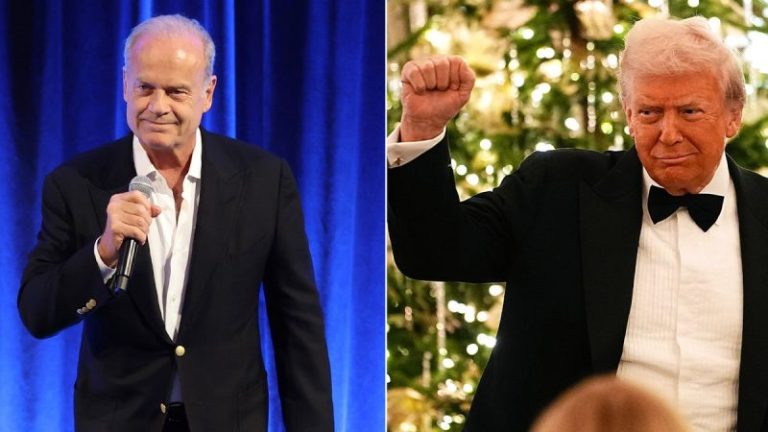
Kelsey Grammer thinks President Donald Trump is ‘one of the greatest presidents we’ve ever had.’

Earlier Saturday, Trump awarded the 2025 Kennedy Center honorees with their medals in the Oval Office. After the ceremony, the State Department Kennedy Center Honors medal presentation dinner was held.

This year’s recipients include Sylvester Stallone, Gloria Gaynor and George Strait, Michael Crawford and the members of KISS.

Speaking to Fox News Digital ahead of the dinner, Grammer, who was accompanied by his daughter Faith, called Trump ‘extraordinary.’

‘I think he’s extraordinary. He’s one of the greatest presidents we’ve ever had. Maybe the greatest. There are some things he still wants to get done, and I think that’s terrific, but there was a big hill to climb,’ Grammer said.

‘I think he’s extraordinary. He’s one of the greatest presidents we’ve ever had. Maybe the greatest.’

— Kelsey Grammer

‘And we were left with some very interesting things going on,’ he concluded.

The ‘Cheers’ star also touched on Stallone being honored during this year’s ceremony and said he’s ‘over the moon’ about it.

‘I was on the selection committee, so I knew about it,’ he added. ‘He’s a force of nature. Sylvester Stallone has captured our imagination in several different roles and performed them beautifully.’

Grammer said it was ‘about time’ that Stallone was honored.

Strait spoke to Fox News Digital on the red carpet and said, ‘It’s a great honor’ to be recognized by the Kennedy Center Honors.

During the Oval Office ceremony, Trump called the honorees ‘incredible people’ who represent the ‘very best in American arts and culture.’

‘I know most of them, and I’ve been a fan of all of them,’ Trump said, according to the Associated Press.

‘This is a group of icons whose work and accomplishments have inspired, uplifted and unified millions and millions of Americans. This is perhaps the most accomplished and renowned class of Kennedy Center Honorees ever assembled,’ Trump continued.

During the ceremony, Trump appointed each honoree with a newly designed medal, donated and created by jeweler Tiffany & Co.

It’s a gold disc etched on one side with the Kennedy Center’s image and signature rainbow colors. The honoree’s name and the ceremony date appear on the reverse. 

The medallion hangs from a navy-blue ribbon, replacing the original large rainbow ribbon – adorned with three gold plates – that rested on the honoree’s shoulders and chest and had been used since the first Honors program in 1978.

The Associated Press contributed to this report.

This post appeared first on FOX NEWS
NioCorp Developments (NASDAQ:NB) has completed the US$8.4 million acquisition of the manufacturing assets and intellectual property of Massachusetts-based FEA Materials.

NioCorp expects the move to position it as a domestic producer of aluminum-scandium (Al-Sc) master alloy amid growing demand for the material in defense and commercial markets.

The all-cash purchase complements NioCorp’s Elk Creek critical minerals project in Nebraska, where it aims to produce scandium oxide alongside niobium, titanium and potentially rare earths once fully financed and operational.

FEA’s proprietary process converts scandium oxide directly into Al-Sc master alloy, bypassing intermediate metal production. NioCorp is also assessing the feasibility of producing finished Al-Sc alloy parts via casting, forging and machining for original equipment manufacturers in the US.

“This strategic acquisition positions NioCorp to potentially build America’s first vertically integrated scandium supply chain from mine to finished alloy parts,” NioCorp CEO Mark A. Smith said in a press release.

Eugene Prahin, CEO of FEA, praised NioCorp’s vertically integrated approach, adding that the company’s alloying technology “will be key to growing scandium-based structural alloys in the years to come.”

The FEA acquisition follows a US$10 million Pentagon Title III award to NioCorp’s subsidiary Elk Creek Resources. Announced in August, it is geared at supporting scandium oxide production.

NioCorp is also collaborating with Lockheed Martin (NYSE:LMT) on aerospace-grade Al-Sc components.

“Working jointly with the Pentagon, NioCorp is committed to insulating the US from market manipulation by China, which has historically constrained scandium-based technologies,’ said Smith.

With the latest acquisition and the government funding, NioCorp envision building a complete US mine-to-market supply chain for scandium, spanning extraction, alloy production and finished parts manufacturing.

Securities Disclosure: I, Georgia Williams, hold no direct investment interest in any company mentioned in this article.

This post appeared first on investingnews.com

The Senate is quietly winning the battle over states’ abilities to craft their own artificial intelligence (AI) regulations, but there is still a desire to chart out a rough framework at the federal level. 

The issue of a blanket AI moratorium, which would have halted states from crafting their own AI regulations, was thought to have been put to bed over the summer. But the push was again revived by House Republicans, who were considering dropping it into the annual National Defense Authorization Act. 

However, Republicans in the lower chamber have pulled back from that push, even as the White House has pressed Congress to create a federal framework that would make regulations more cohesive across the country. 

A trio of Senate Republicans, Sens. Josh Hawley of Missouri, Marsha Blackburn of Tennessee and Ron Johnson of Wisconsin, who banded together to block the original proposal, cheered the provision’s apparent rise from the grave.

Hawley told Fox News Digital that it was good news that the provision would not be included in the defense authorization bill, but warned that ‘vigilance is needed, and Congress needs to act.’

‘I mean, for everybody out there saying, ‘Well, Congress needs to act and create one standard,’ I agree with that,’ he said. ‘And we can start by banning chat bots for minors.’ 

Sen. Ted Cruz, R-Texas, who chairs the Senate Commerce, Science and Transportation committee, initially pushed for a moratorium to be included in Trump’s One Big, Beautiful Bill. His position on the issue has been to unchain AI to give the U.S. a competitive edge against foreign adversaries like China.

But that attempt was nearly unanimously defeated over the summer and stripped from the bill. And Cruz hasn’t given up.

‘The discussions are ongoing, but it is the White House that is driving,’ Cruz told Fox News Digital. 

Senate Majority Leader John Thune, R-S.D., acknowledged that getting the moratorium into the defense authorization bill would be difficult earlier in the week.

‘That’s controversial, as you know,’ Thune said. ‘So, I mean, I think the White House is working with senators and House members for that matter to try and come up with something that works but preserves states’ rights.’

Trump declared last month that the U.S. ‘MUST have one Federal Standard instead of a patchwork of 50 State Regulatory Regimes,’ and argued that over regulation at the state level was threatening the investment, and expected growth, of AI. 

The White House reportedly drafted an executive order that would have blocked states from regulating AI that would have withheld certain streams of federal funding from states that didn’t comply with the order, and enlisted the Department of Justice to sue states that crafted their own regulations.

So far, Trump has not taken action on the order. 

Blackburn, who was the leading player in thwarting Cruz’s previous attempt to assert an AI moratorium into Trump’s marquee tax bill, also wants some kind of federal framework, but one that is designed to ‘protect children, consumers, creators, and conservatives,’ a spokesperson for Blackburn told Fox News Digital in a statement. 

‘Senator Blackburn will continue her decade-long effort to work with her colleagues in both the House and Senate to pass federal standards to govern the virtual space and rein in Big Tech companies who are preying on children to turn a profit,’ the spokesperson said.

And Johnson, another key figure in blocking the moratorium earlier this year, argued to Fox News Digital that it was an ‘enormously complex problem. It’s my definition of a problem.’ 

But unlike his counterparts, he was more skeptical about Congress producing a framework that he would be comfortable with.

‘I’m not a real fan of this place,’ Johnson said. ‘And I think we’d be far better off if we passed a lot fewer laws. I’m not sure how often we get it right. Look at healthcare, look at how that’s been completely botched.’ 

‘What are we gonna do with AI? Hard to say, but we just don’t go through the problem-solving process,’ he continued. ‘And again, I’m concerned, the real experts on this have got vested interests. Whatever they’re advising is, can you really trust them?’

This post appeared first on FOX NEWS
As a Democrat who’s been on winning and losing presidential campaigns against Donald Trump, it’s clear to me that the Republican Party’s top competitive edge in recent elections was its anti-establishment populist message. I say ‘message’ because actions always matter more than words — especially when the actions contradict the words. That’s happening now. Trump and Vance are breaking their promises to stand up for everyday Americans against corrupt elites.

The prices Trump and Vance ran on vowing to ‘immediately’ lower — groceries, healthcare, electricity bills – have gone up, while economic growth is down. We’re seeing ‘recession-level’ job loss and unprecedented welfare for the rich. 

As a result, Trump and Vance are crippling Republicans’ flagship political advantage, creating new divides in their party and the country. Those shifts are big openings for Democrats on voters’ #1 issue, their finances. By the same token, if I were one of the Republicans already navigating the 2028 shadow primary, I’d see growing opportunities to outcompete JD Vance.

The Constitution blocks Trump from running again. Even if it didn’t, Trump’s diminishing energy levels and judgment make him a lame duck regardless. Case in point, the President of the United States is building himself an assisted-living theme park on the White House grounds while dismissing Americans’ concerns about affordability. This kind of antipopulist record is becoming significant baggage for Vance, making him a target for Republicans as well as Democrats.

For example, it’s hard to imagine anything less populist — or more un-Christian — than partying with billionaires while taking food away from working families. Or forcing middle class Americans to pick up the tab for AI datacenters backed by some of the richest companies in history. 

In the Biden White House, we saw firsthand how damaging it is for the party in power if a majority of Americans rate the economy negatively. Voters’ economic sentiment sets the political tone. 

In November, the party that controls Washington lost elections all over the country. From New Jersey Gov.-elect Abigail Spanberger to New York City Mayor-elect Zohran Mamdani, Democrats ran disciplined, cost-of-living campaigns. That issue has staying power and can unite Democrats with newly persuadable independents and Republicans. It happened again this week, with Republicans barely hanging onto a deep-red Tennessee congressional district.

Sadly, for those of us who can’t afford to ingratiate ourselves the Trump-Vance administration by purchasing Trump’s meme coin or joining Donald Trump Jr.’s ‘Executive Branch’ club, their agenda is sowing seeds for an even weaker economy. 

First, there’s healthcare. Having already made the biggest Medicaid cuts in history, Washington Republicans want to terminate Democratic health care tax credits for working people, making premiums skyrocket for millions and taking coverage from more. 

Second, tens of thousands are losing their jobs to AI – a rapidly accelerating trend. While it’s in America’s interest to lead the world when it comes to AI, the Trump-Vance administration — whose AI czar is himself a corrupt billionaire — is treating millions of Americans’ livelihoods as expendable, failing to equip workers for a successful economic future. By contrast, Democrats like Sen. Bernie Sanders and Rep. Jake Auchincloss  are working to ensure we win the AI race while fighting to protect blue and white collar workers.

Then there’s energy. After raising electricity bills with the most severe clean energy cuts on record, Republican majorities are helping extremely rich people charge working families for their datacenters’ energy consumption. The Trump-Vance record on monopolistic megamergers will also come back to haunt them.

These realities all trap Vance between a rock and a hard place. Trump demands unquestioning loyalty from subordinates like Vance, but other likely candidates have more autonomy. For example, Georgia Rep. Marjorie Taylor Green, has attacked the White House for high prices.

Greene isn’t alone among Republicans in distancing herself from the administration. When Nick Fuentes, a Holocaust-denying neo-Nazi, said ‘organized Jewry’ was the biggest threat to America, Trump and Vance’s response to Fuentes was pathetically weak. But Texas Senator Ted Cruz, another possible candidate, blasted Fuentes. 

There’s also growing bipartisan opposition to the administration’s warmongering toward Venezuela. Americans don’t want servicemembers risking their lives to distract from a billionaire president’s falling approval ratings.

What has been Vance’s biggest asset with fellow Republicans –his closeness with Trump –could become his rivals’ key to undermining him. Democrats are doing it now. Last month, Pennsylvania Gov. Josh Shapiro, a popular swing state Democrat, blasted Vance for taking food away from the hungry while cutting taxes for billionaires. Then he signed a new tax credit for working families into law, delivering $193 million in tax relief for 940,000 Pennsylvanians.

Republicans’ ‘Golden Age’ is turning into a second Gilded Age, where tax breaks for the wealthy are funded by higher costs for everyone else.

Across all political boundaries, Americans want leaders who will actually listen to them.

This post appeared first on FOX NEWS
Silver is known as the most versatile precious metal, and its end uses range from silverware to medicine, as well as industrial and technological applications, which account for well over half of annual global demand.

In 2024, global physical silver demand reached 1.16 billion ounces, shy of the record of 1.28 billion ounces set in 2022, as per the Silver Institute’s latest World Silver Survey released in April 2025.

Industrial demand is on an upward trend from the push toward renewable energy — in particular, silver demand should benefit from the expansion of the solar energy sector, electric vehicles and the growing use of AI and data centers. The metal is a great conductor of both heat and electricity, making it perfect for use in solar panels.

In 2025, the Silver Institute expects global demand for silver to decline by 1 percent to 1.15 billion ounces, but remain at historically high levels. With all of that in mind, here’s a look at four factors driving silver demand.

1. Industrial fabrication

Expected demand in 2025: 677.4 million ounces

Silver is the best electrical and thermal conductor of all the metals, so it’s no surprise that it’s used in industrial fabrication. Industrial silver demand has seen steady growth in recent years. Coming in at just 491 million ounces in 2016, industrial demand rose to 592.3 million ounces in 2022, 657.1 million ounces in 2023 and a record 680.5 million ounces in 2024.

For 2025, the Silver Institute believes industrial demand will see a slight regression of 0.5 percent to 677.4 million ounces.

Here’s a brief rundown of the main industrial uses driving silver demand:

Electronics — In electronics, industrial silver is used mainly in multi-layer ceramic capacitors, membrane switches, silvered film, electrically heated automobile windshields, conductive adhesives and the preparation of thick-film pastes.

Electronics is expected to remain an important driver for silver going forward, as per the Silver Institute, which expects overall industrial silver consumption to reach 456.6 million ounces in 2025. Photovoltaics form the largest portion of electronic demand, totaling 197.6 million tons in 2024.

Using silver as conductive ink, photovoltaic cells transform sunlight into electricity. These cells are combined to form solar panels. The use of silver in the fabrication of photovoltaic cells, also known as solar cells, is seen as an area of rapid growth in the short to medium term. In fact, SolarPower Europe reported that total installations reached 2.2 terawatts by the end of 2024, and are expected to more than triple to more than 7 terawatts by 2030.

Automotive industry — Every electrical action in a modern car is activated with silver-coated contacts. Basic functions such as starting the engine, opening power windows, adjusting power seats and closing power trunks are all activated using a silver membrane switch. Furthermore, in January 2021, the Silver Institute reported that, depending on the model, battery electric vehicles contain between 25 and 50 grams of silver, while hybrid vehicles use 18 to 34 grams of silver. That’s compared to 15 to 28 grams of silver in a light internal combustion engine vehicle.

The Silver Institute has projected that automotive demand for silver could reach 90 million ounces by 2025. The association states that silver demand from the car industry will be driven by infrastructure investment, broader decarbonization efforts and the expansion of charging stations.

Brazing and soldering — Adding silver to the process of soldering or brazing helps produce smooth, leak-tight and corrosion-resistant joints when combining metal parts. In addition, silver-brazing alloys are used widely in everything from air conditioning and refrigeration to electric power distribution. The Silver Institute predicts demand from this segment to total 52.9 million ounces in 2025.

2. Jewelry

Expected demand in 2025: 196.2 million ounces

Jewelry is often what laypeople think about when they consider silver demand. And for good reason — few materials are better suited for jewelry than silver. Lustrous but resilient, silver responds well to sculpting, requires minimal care and lasts a lifetime.

While silver and gold possess similar working qualities, the white metal enjoys greater reflectivity and can achieve a brilliant polish. A vast amount of silver supply from mine production gets turned into a form of jewelry. The segment grew moderately by 3 percent in 2024, rising to 208.7 million ounces, but the Silver Institute is predicting a significant reversal in 2025, with a 6 percent decline to 196.2 million ounces.

3. Silver bullion, coins and bars

Expected demand in 2025: 204.4 million ounces

Another source of silver demand is for silver as an investment in the form of silver coins, bars and rounds. This category includes the silver used to fabricate the bullion, as well as small bar purchases by retail investors, according to the Silver Institute.

Silver coins have a long history. Minted silver coins were first used in the Eastern Mediterranean region in 550 BCE, and by 269 BCE the Roman Empire had adopted silver as well. Silver was the main circulating currency until the 19th century, when it was phased out of regular coinage.

While silver is not used in many circulating coins today, mints in many countries still create high-purity bullion coins and bars for investors.

Physical silver investment demand reached a record high of 338.3 million ounces in 2022, but declined considerably to 244.3 million ounces in 2023, before falling another 22 percent to 190.9 million ounces in 2024.

However, with rising uncertainty in global financial markets, the institute is predicting 7 percent growth in 2025 to 204.4 million ounces.

Silver exchange-traded products (ETPs) and silver ETFs purchase significant amounts of physical silver. Silver ETPs have experienced high volatility over the last five years, with demand peaking in 2020 with net inflows of 331.1 million ounces of silver, which fell to to 64.9 million ounces in 2021. Following the pandemic, ETPs experienced heavy outflows with investors selling off 117.4 million ounces in 2022 and 37.6 million ounces in 2023.

In 2024, as uncertainty began to seep into global financial markets, investors once again returned to ETPs, pushing demand to 61.6 million ounces of silver flowing into the products.

The Silver Institute expects demand to grow by 14 percent in 2025 to 70 million ounces, attributing these inflows to cuts to the Federal Funds rate, concerns over US debt load, and instability in the Middle East.

4. Silverware

Expected demand in 2025: 46 million ounces

Sterling silver has been the standard for silver holloware and silver flatware since the 14th century. Silver cutlery and other decor lasts for generations as it resists tarnish and is a traditional decoration in homes around the world. Base metal copper is mixed with silver to strengthen it for use as cutlery, bowls and decorative items.

Demand for the metal from the silverware industry reached 73.5 million ounces in 2022 but has declined since then to 54.2 million ounces in 2024. The Silver Institute expects the market to shed another 15 percent in 2025 to 46 million ounces.

Securities Disclosure: I, Melissa Pistilli, hold no direct investment interest in any company mentioned in this article.

This post appeared first on investingnews.com

Highlight Drill Results:

GS2508

1.05 g/t Au over 120.7 m in the Cleary Zone

GS2528

1.78 g/t Au over 61 m in the Cleary Zone

GS2531

1.53 g/t Au over 191.3 m in the Dolphin Zone

Note: The reported widths refer to drill hole intercepts; true width cannot be determined due to the uncertain geometry of mineralization.

VANCOUVER, BC, Dec. 4, 2025 /CNW/ – Freegold Ventures Limited (TSX: FVL,OTC:FGOVF) (OTCQX: FGOVF) announces results from six additional drill holes at the Golden Summit project. In 2025, a total of 62 holes were drilled, with assay results for 29 holes reported to date. Reporting assay results will continue in the coming months. The results from the 2025 and first half of 2026 drilling programs will be used to update the mineral resource estimate (MRE) published in July 2025, which reported 17.2 million ounces at 1.24 g/t Au indicated and 11.9 million ounces at 1.04 g/t Au inferred. The updated MRE and subsequent drilling in 2026 will serve as the basis for the Pre-Feasibility Study (PFS), scheduled for completion in early 2027. In addition to the extensive drill program, a range of other activities supporting the PFS are in progress. These include cultural resource assessments, paleontology, groundwater studies, power supply analysis, mammal habitat evaluations, and continuing metallurgical test work.

2025 Program Overview
The 2025 drilling program has been highly successful, focusing on the Cleary, Dolphin, and WOW zones. Efforts have centered on infill drilling to support the PFS, refining both geological and resource models, and developing a conceptual higher-grade starter pit targeting 5-10 million ounces to enhance the project’s early economic potential. Mineralization remains open both to the east and west of the current deposit.

Kristina Walcott, President and CEO of Freegold, commented, ‘The potential scale of this deposit is truly amazing. Our current exploration efforts focused on defining an area to host an attractive potential starter pit, as we continue to move the project forward through PFS’.  Further infill drilling in early 2026 is expected to refine this area further.

Metallurgical Test Work
Metallurgical testing continues to evaluate the most viable process flowsheets for Golden Summit material. Gold recovery rates exceeding 90% have been achieved using a flowsheet that includes gravity concentration, flotation to produce a cleaner concentrate, and subsequent treatment with sulphide-oxidizing techniques such as BIOX®, POX, and the Albion Process, producing feed for carbon-in-leach (CIL) for additional gold recovery.  Simple gravity and CIL are also being evaluated. This testwork is crucial to maximize the resource’s potential and will underpin the many trade-off scenarios to be evaluated during the Pre-Feasibility stage.

Current Drilling Status
Five drill rigs are currently completing the final holes of the season. Drilling will gradually wind down for a seasonal break and resume in February 2026.

Dolphin Zone: Higher-Grade Potential
Recent drilling in the Dolphin zone confirms strong, continuous mineralization, with broad intercepts of higher grades. The near-surface intercept in GS2531 indicates promising potential for higher grades, supporting the concept of a potential higher-grade starter area.

At depth, hole GS2531 shows excellent correlation with the current model, with an intercept of 1.53 g/t Au over 191.3m within the modelled higher-grade schist domain. This corridor remains open to the southwest and extends into the intrusive domain at depth. Hole GS2542, drilled 200 m south of GS2531, aims to extend the zone downdip, with assays pending.  Several other holes are planned for this potential higher-grade domain in 2026, as it may serve as the economic keel for a potential starter pit.

Hole

Depth (m)

Dip (°)

Azimuth (°)

From (m)

To (m)

Interval (m)

Au (g/t)

GS2515

602.5

-80

360

84.4

99.7

15.3

3.00

142.3

147.5

5.2

0.81

175.3

181.7

6.4

13.53

227.9

232.8

4.9

3.06

303.9

313.0

9.1

1.71

396.2

416.6

20.4

0.79

GS2531

703.2

-90

360

35.6

38.7

3.1

9.33

53.9

62.7

8.8

2.05

81.4

83.8

2.4

9.51

102.4

143.5

41.1

1.06

330.3

361.5

31.2

0.87

386.2

577.5

191.3

1.53

Note: The reported widths refer to drill hole intercepts; true width cannot be determined due to the uncertain geometry of mineralization.

GS2515, drilled in the northern Dolphin Zone, intersected higher-grade mineralization with 3.0 g/t Au over 15.3m from 84.4 m, 13.53 g/t over 6.4m from 175.3m, and 3.06 g/t Au over 4.9m from 227.9 m. Like GS2531, located 250m to the south, GS2515’s higher-grade, closer-to-surface intercepts provide further encouragement for the development of a potential starter pit. Planned shallow infill drilling in 2026 will further target these areas.

Cleary Zone: Drilling Results Continuing to demonstrate strong correlation with resource model
Infill drilling within the Cleary Zone continues to demonstrate a strong correlation with the current resource model. Hole GS2508 returned 1.05 g/t Au over 120.7m, while hole GS2528 encountered four intervals with higher grades and widths, notably 1.6 g/t Au over 57.9m and 1.78 g/t Au over 61m, as well as two narrower, higher-grade sections. Hole GS2517, designated for hydrological investigation targeted the potential higher-grade downdip extent, was abandoned due to challenging ground conditions and complications arising from the attempted installation of a vibrating Wire Piezometer (VWP). VPWs are being installed to monitor groundwater levels throughout the prospective pit area, capturing both vertical and horizontal gradients to inform analyses of possible fault-block compartmentalization and support ongoing groundwater monitoring efforts. Eight installations were completed during 2025. A follow-up vertical hole, GS2549, was drilled from the same collar as GS2517 to access the target zone; assay results are pending.

Hole

Depth (m)

Dip (°)

Azimuth (°)

From (m)

To (m)

Interval (m)

Au (g/t)

GS2508

502

-75

360

224.6

345.3

120.7

1.05

364.8

373.7

8.9

0.91

GS2517*

593.4

-75

360

477.6

546.5

68.9

0.64

GS2524

413.3

-90

0

17.4

23.5

6.1

1.34

141.7

148.4

6.7

1.12

203.3

209.4

6.1

3.36

GS2528

721.2

-90

0

86.0

102.7

16.7

0.98

325.2

328.3

3.1

35.09

416.7

474.6

57.9

1.60

514.2

544.1

29.9

0.70

559.9

620.9

61.0

1.78

670.6

672.7

2.1

35.65

Note: The reported widths refer to drill hole intercepts; true width cannot be determined due to the uncertain geometry of mineralization. *Hole GS2517 was drilled for both infill and hydrogeological purposes.

Metallurgical Update: Environmental Characterization – Non-Acid-Generating Tailings
Recent metallurgical work results have also shown more positive developments. Tailings from the locked-cycle flotation tests were analyzed for environmental characterization, including Acid Base Accounting (ABA) and Toxicity Characteristic Leaching Procedures (TCLP). Tailings from the flotation-based flowsheet have been classified as low risk for acid generation due to the removal of sulphur and the presence of significant amounts of calcium carbonate. Gravity tailings from the CIL leach scenario also showed arsenic levels below acceptable limits. More specifically, results showed the Neutralization Potential to Acid Generating Potential ratio (NPR) of the flotation tailings was significantly above what is typically classified as non-acid generating.

About Golden Summit
Since 2020, the Golden Summit project has emerged as one of North America’s largest undeveloped gold resources. The increase in resource ounces and grade is attributed to targeted drilling campaigns (over 130,000 metres from 2020 to 2024), improvements to geological models, and a better understanding of mineralization controls. Positive metallurgical test results have further advanced the project. Ongoing drilling continues to delineate zones of higher-grade mineralization, converting previously considered waste areas into potentially economically viable zones.  Continued westward expansion has led to the discovery of new, higher-grade zones.

As of July 2025, the Golden Summit resource includes an Indicated Primary Mineral Resource of 17.2 million ounces at 1.24 g/t Au and an Inferred Primary Mineral Resource of 11.9 million ounces at 1.04 g/t Au, calculated using a 0.5 g/t cut-off grade and a three-year trailing average gold price of $2,490.

Drilling will continue into 2026, with upcoming results expected to support an updated resource estimate. A significant number of assay results remain pending.

Links to the Plan Map and Section 470505E

https://freegoldventures.com/site/assets/files/6287/nr-2025-drilling-20251204.jpeg

https://freegoldventures.com/site/assets/files/6287/e479050_section_04122025.pdf

QA/QC
HQ Core is logged, photographed and cut in half using a diamond saw. One half is placed in sealed bags for preparation and subsequent geochemical analysis by MSA Laboratories in Fairbanks, Alaska or ALS’s facilities in Vancouver and Thunder Bay.  At MSALABS, the entire sample will be dried and crushed to 70% passing -2mm (CRU-CPA). A ~500g riffle split was analyzed for gold using CHRYSOS PhotonAssay (CPA-Au1). From this, 250g will be further riffle-split from the original PhotonAssay sample, pulverized, and a 0.25g sub-sample analyzed for multi-element geochemistry using MSA’s IMS230 package, which includes 4-acid digestion and ICP-MS finish. MSALABS operates under ISO/IEC 17025- and ISO 9001-certified quality systems.

Core samples were delivered to ALS’s facility in Vancouver, Canada, where each sample was crushed to 70% passing a 2 mm (Tyler 9 mesh, U.S. Std. No. 10) screen.  A representative ~500 g subsample was obtained by riffle splitting (SPL-32a) and analyzed for gold using the ALS method Au-PA01 (Photon Assay), which provides a detection range of 0.03 to 350 ppm, in Thunder Bay.

In addition, a subsample was analyzed for multi-element geochemistry using the ALS method ME-ICP61 (34-element, four-acid ICP-AES).

A QA/QC program includes laboratory and field standards inserted in every ten samples. Blanks are inserted at the start of the submittal, and at least one blank every 25 standards.

The Qualified Person for this release is Alvin Jackson, P.Geo., Vice President of Exploration and Development for Freegold, who has approved the scientific and technical disclosure in this news release.

About Freegold Ventures Limited
Freegold is a TSX-listed company focused on exploration in Alaska.

Some statements in this news release contain forward-looking information, including, without limitation, statements as to planned expenditures and exploration programs, potential mineralization and resources, exploration results, the completion of an updated NI 43-101 technical report, and any other future plans. These statements address future events and conditions and, as such, involve known and unknown risks, uncertainties, and other factors which may cause the actual results, performance, or achievements to be materially different from any future results, performance, or achievements expressed or implied by the statements. Such factors include, without limitation, the completion of planned expenditures, the ability to complete exploration programs on schedule, and the success of exploration programs. See Freegold’s Annual Information Form for the year ended December 31st, 2024, filed under Freegold’s profile at www.sedar.com, for a detailed discussion of the risk factors associated with Freegold’s operations.

SOURCE Freegold Ventures Limited

View original content to download multimedia: http://www.newswire.ca/en/releases/archive/December2025/04/c4300.html

News Provided by Canada Newswire via QuoteMedia

This post appeared first on investingnews.com

Outages on Shopify’s e-commerce platform have been resolved, the company said late Monday, bringing to an end a daylong glitch on the annual ‘Cyber Monday’ shopping day.

Some merchants that use Shopify’s service to sell goods online said they experienced issues with checkouts through the company’s point-of-sale system.

Businesses that run on Shopify also had trouble logging into their administrative portals.

In a statement, Shopify said: ‘We had a system degradation that has now been mitigated.’

Throughout the day, business owners posted angry messages directed at the company on X, where Shopify President Harvey Finkelstein had posted ‘HAPPY CYBER MONDAY! Let’s finish strong!’ earlier in the day, with an emoji of a flexed arm.

One business, Costack Spices, based in London, replied: ‘How??? [We] cannot fulfill orders or log on,’ with three red-faced emojis. In a follow-up, the company posted, ‘This is unbelievable.’

Another user wrote, ‘@ShopifySupport I haven’t been able to access it for the last couple hours.’

Shopify replied to most users on X with the same message: ‘We are aware of an issue with Admins impacting selected stores, and are working to resolve it.’

In 2024, merchants using Shopify services recorded $11.5 billion in sales from Black Friday through Cyber Monday, the company said, with more than 76 million customers buying from businesses powered by the platform.

Shopify provides website design tools, online checkout services and digital advertising products to businesses of all sizes. The company says that millions of merchants use its services.

While Shopify’s share of Cyber Monday sales may be limited, smaller businesses that rely on the company to process their transactions may have missed out on crucial sales at the start of the all-important holiday season.

Total Cyber Monday sales are expected to be more than $53 billion, according to Salesforce.

Shopify stock ended the trading day down 5.9%.

This post appeared first on NBC NEWS

Absent direct military action, President Donald Trump is running low on options amid his standoff with Venezuelan President Nicolás Maduro, according to experts.

Strikes near Venezuelan waters aimed at drug traffickers, sanctions and a $50 million bounty have so far been unsuccessful in forcing Maduro, whom the U.S. has designated as a leader of the Tren de Aragua drug cartel, to step down from power.

After repeated threats, adversaries may now view a lack of direct military action as a sign of weakness from the U.S. But Maduro is in an equally difficult position — his own military capabilities are dwarfed in comparison to Trump’s, and experts say China and Russia lack the will to directly challenge the U.S. in its own hemisphere.

Meanwhile, the clock is ticking: Trump’s unprecedented military buildup in the Caribbean — including sending the world’s largest aircraft carrier to the region — is taking away resources from other theaters.

Katherine Thompson, a senior fellow in defense and foreign policy studies at the libertarian think tank the Cato Institute, said that there are very few tools left at Trump’s disposal to oust Maduro, aside from a targeted strike against the Venezuelan leader or a land invasion. 

While the White House has not directly said that it is seeking regime change, recent media reports indicate that Trump and Maduro have spoken about the Venezuelan leader departing his post.

Thompson noted that previous efforts to squeeze out Maduro, including imposing sanctions on Venezuela and backing opposition leader Juan Guaidó during Trump’s first term, have proven unsuccessful. 

‘It does not seem like there is — outside of the military option — anything new on the table that hasn’t really been tried,’ Thompson said.

Even so, Thompson cast doubt on whether military action would prove successful. 

‘If the offer on the table from the Trump administration is we’re going to potentially execute an invasion unless you talk to us, perhaps that’s a strong enough diplomatic, strategic move that gets Maduro to capitulate,’ Thompson said. ‘But it just doesn’t seem like we’re picking up that many signals from the Maduro regime that that is going to be palatable.’ 

Meanwhile, Thompson said that adversaries like Russia and China are probably confused about why the Trump administration has fixated on the Maduro regime, which doesn’t jeopardize U.S. interests as much as other actors, when the Trump administration has adopted an ‘American First’ mantra. 

‘I imagine for them, it’s probably a bit puzzling, if they’re looking at it through a real, brass tacks, realist lens, why this administration would be prioritizing ousting the Maduro regime, as opposed to conflicts in other theaters,’ Thompson said.

As a result, the Trump administration’s actions focusing on Venezuela likely leave a bit of ‘befuddlement’ on the part of Russia and China about how serious the U.S. is about putting American interests first, Thompson said.

She added that China may be wondering if the U.S. diverting resources, such as directing the aircraft carrier USS Gerald R. Ford to the Caribbean, could provide an opportunity for it to invade Taiwan if the U.S. is tied up with operations in Venezuela. Multiple U.S. officials have said they believe China will be capable of invading Taiwan by 2027. 

Will Russia and China back Venezuela? 

While there may be greater interest from China to take action within its own theater, experts agreed it was unlikely that Russia or China would actually get involved and back Venezuela should military operations between the U.S. and Caracas escalate — even though Moscow and Beijing are strategic allies with Venezuela. 

Some analysts said Maduro would find himself largely isolated if Trump launched military strikes against Venezuela. Russia, still consumed by its war in Ukraine, is unlikely to offer anything beyond denunciations of U.S. action, and China, despite years of deep economic engagement with Caracas, is also expected to stop well short of military involvement, they said. 

From Moscow’s perspective, there is both ideological and strategic discomfort with an American intervention — but little appetite or capability to counter it.

‘Moscow opposes unilateral U.S. military intervention, especially when aimed at toppling a friendly authoritarian regime. That said, Russia lacks the will and ability to stop U.S. intervention in this part of the world should Trump decide to go that route,’ said John Hardie, a Russian military analyst at the Foundation for Defense of Democracies (FDD).

Hardie said Russia is watching Washington’s internal debate carefully. 

‘Analysts in Moscow interpret the internal debate in Washington over Venezuela as evidence that although Republican views on foreign policy are shifting, the more traditional, hawkish camp still retains influence,’ Hardie said. ‘This whole episode probably also reinforces Russian views of Trump as unpredictable and impulsive, though I suspect Moscow is glad to see Trump prioritizing the Western Hemisphere over other regions more central to Russian interests.’

China’s likely response would mirror its recent behavior in other conflicts. Beijing has major financial stakes in Venezuela but has shown little willingness to risk confrontation with the United States, especially in the Western Hemisphere.

Jack Burnham, a China analyst at FDD, said Maduro should take note of how China behaved during the 12-Day War, when Iran came under intense U.S.- and Israeli-led strikes.

‘If Maduro is expecting support from China, he should have had his expectations corrected by Tehran’s recent experience under fire,’ Burnham said. ‘Despite China providing key war-related materials to Iran prior to the 12 Day War, once the conflict escalated, Beijing stood down, content to stand on the sidelines and offer statements.’

Burnham said that same pattern would likely apply now: ‘If American military action accelerates, look for Beijing to engage in a war of words rather than send badly needed supplies to Caracas.’

Trump’s crusade against drugs

The Trump administration has beefed up its military presence off the coast of Venezuela and has adopted a hard-line approach to address the flow of drugs into the U.S. For example, it designated drug cartel groups like Tren de Aragua, Sinaloa and others as foreign terrorist organizations in February.

The Trump administration has repeatedly said it does not recognize Maduro as a legitimate head of state, but instead, a leader of a drug cartel. In August, the Trump administration upped the reward for information leading to Maduro’s arrest to $50 million, labeling him ‘one of the largest narco-traffickers in the world.’

On Sunday, Trump confirmed that he spoke to Maduro over the phone last week, after the New York Times reported that the two had talked, but declined to provide specifics on what they discussed. However, The Miami Herald reported on Sunday that Trump gave Maduro an ultimatum, guaranteeing the Venezuelan leader and his family safety — if he resigned immediately. 

The White House did not provide comment when asked if the Trump administration is pushing a regime change, and whether Maduro had been offered any incentives to step down. However, the officials said all options are on the table to mitigate the influx of drugs into the U.S. 

‘President Trump has been clear in his message to Maduro: stop sending drugs and criminals to our country,’ White House spokesperson Anna Kelly said in a statement to Fox News Digital on Tuesday. ‘The President is prepared to use every element of American power to stop drugs from flooding in to our country.’

The White House did not respond to a request for comment from Fox News Digital on The Miami Herald’s report. 

Additionally, the New York Post reported on Tuesday that U.S. officials are discussing potentially sending Maduro to Qatar, although officials familiar with Qatar’s role in the negotiations said Maduro will not head there. It’s unclear where Maduro would flee to, and no countries have confirmed they will accept him. 

Trump’s reported negotiation with Maduro comes as the strikes in the Caribbean are facing heightened scrutiny from the legal community and lawmakers.

While lawmakers have questioned the legality of the strikes since the beginning, the attacks have come under renewed scrutiny after the Washington Post reported on Friday that Secretary of War Pete Hegseth verbally ordered everyone onboard the alleged drug boat to be killed in a Sept. 2 operation. The Post reported that a second strike was conducted to take out the remaining survivors on the boat. 

On Monday, the White House confirmed that a second strike had occurred, but disputed that Hegseth ever gave an initial order to ensure that everyone on board was killed when asked specifically about Hegseth’s instructions.

The White House also said Monday that Hegseth had authorized Adm. Frank ‘Mitch’ Bradley to conduct the strikes, and that Bradley was the one who ordered and directed the second one. 

At the time of the Sept. 2 strike, Bradley was serving as the commander of Joint Special Operations Command, which falls under U.S. Special Operations Command. He is now the head of U.S. Special Operations Command. 

According to Hegseth, carrying out a subsequent strike on the alleged drug boat was the right call. 

‘Admiral Bradley made the correct decision to ultimately sink the boat and eliminate the threat,’ Hegseth said Tuesday. 

Altogether, the Trump administration has conducted more than 20 strikes against alleged drug boats in Latin American waters, and has enhanced its military presence in the Caribbean to align with Trump’s goal to crack down on drugs entering the U.S.

The last confirmed strike occurred on Nov. 15. Hegseth said Tuesday that although there has been a pause in strikes in the Caribbean because alleged drug boats are becoming harder to find, the Trump administration’s crusade against drugs will continue. 

‘We’ve only just begun striking narco-boats and putting narco-terrorists at the bottom of the ocean because they’ve been poisoning the American people,’ Hegseth said Tuesday. 

This post appeared first on FOX NEWS