Author

admin

Browsing

NOT FOR DISTRIBUTION TO UNITED STATES NEWS WIRE SERVICES
OR FOR DISSEMINATION IN THE UNITED STATES

Osisko Metals Incorporated (the ‘ Company ‘ or ‘ Osisko Metals ‘) (TSX: OM,OTC:OMZNF; OTCQX: OMZNF; FRANKFURT: OB51) is pleased to announce that it expects to complete a non-brokered private placement with certain strategic investors for an aggregate of approximately 67,666,666 common shares of the Company (the ‘ Common Shares ‘) at an offering price of $0.48 per Common Share for aggregate gross proceeds to the Company of approximately $32,480,000 (the ‘ Private Placement ‘).

The Private Placement is expected to include subscriptions from certain strategic investors, including:

  • Hudbay Minerals Inc. : 29,166,666 Common Shares for gross proceeds of $14,000,000;
  • Agnico Eagle Mines Limited : has indicated that it intends to subscribe for 26,000,000 Common Shares for gross proceeds of $12,480,000 pursuant to an existing participation right;
  • Franco-Nevada Corporation : 4,166,667 Common Shares for gross proceeds of $2,000,000; and
  • A strategic institutional investor : 8,333,333 Common Shares for gross proceeds of $4,000,000.

The size of the Private Placement will depend on, among other things, certain contractual participation rights granted by the Company to Glencore Canada Corporation (the ‘ Glencore Participation Right ‘).

Osisko Metals CEO Robert Wares commented: We are pleased to welcome Hudbay Minerals as a new significant shareholder of Osisko Metals. We also appreciate the continued participation of Agnico Eagle and two of our existing principal and strategic shareholders. We view the participation in the private placement by these investors as support for the potential of the Gaspé Copper project and we look forward to continued support from these shareholders as we advance our project.

After giving effect to the Private Placement, but before giving effect to any other issuance of Common Shares (including pursuant to the Glencore Participation Right): (i) Hudbay Minerals Inc. (‘ Hudbay ‘) is expected to beneficially own or control 29,166,666 Common Shares, representing approximately 4.3% of the issued and outstanding Common Shares, calculated on a non-diluted basis; and (ii) Agnico Eagle Mines Limited (‘ Agnico ‘) is expected to beneficially own or control 87,815,000 Common Shares, representing an ownership interest in the Company equal to approximately 12.5% (calculated on a partially-diluted basis). As part of the Private Placement, the Company and Hudbay have agreed to enter into an investor rights agreement, pursuant to which Hudbay will be granted certain rights, including top-up rights and the right to participate in future offerings of securities of the Company upon Hudbay’s ownership interest increasing to 9.9% and, subject to certain minimum ownership thresholds and other conditions, the right to board representation.

The net proceeds of the Private Placement are expected to be used to advance the Company’s Gaspé Copper project (including drilling, permitting and technical studies) and for general corporate purposes. The Private Placement is expected to close on or about December 16, 2025, subject to the negotiation and execution of definitive agreements and the satisfaction of certain customary closing conditions therein, including the conditional approval of the Toronto Stock Exchange (the ‘ TSX ‘).

This news release does not constitute an offer to sell or a solicitation of an offer to buy any of the securities in the United States. The securities have not been and will not be registered under the U.S. Securities Act, or any state securities laws and may not be offered or sold within the United States or to or for the account or benefit of a U.S. person (as defined in Regulation S under the U.S. Securities Act) unless registered under the U.S. Securities Act and applicable state securities laws or an exemption from such registration is available.

About Osisko Metals

Osisko Metals Incorporated is a Canadian exploration and development company creating value in the critical metals sector, with a focus on copper and zinc. The Company acquired a 100% interest in its flagship project, the past-producing Gaspé Copper mine, from Glencore Canada Corporation in July 2023. The Gaspé Copper project is located near Murdochville in Québec’s Gaspé Peninsula. The Company is currently focused on resource expansion of the Gaspé Copper system, with current Indicated Mineral Resources of 824 Mt grading 0.34% CuEq and Inferred Mineral Resources of 670 Mt grading 0.38% CuEq (in compliance with NI 43-101). For more information, see Osisko Metals’ November 14, 2024 news release entitled ‘ Osisko Metals Announces Significant Increase in Mineral Resource at Gaspé Copper ‘. Gaspé Copper hosts the largest undeveloped copper resource in eastern North America, strategically located near existing infrastructure in the mining-friendly province of Québec.

In addition to the Gaspé Copper project, the Company is working with Appian Capital Advisory LLP, through the Pine Point Mining Limited joint venture, to advance one of Canada’s largest past-producing zinc mining camps, the Pine Point project, located in the Northwest Territories. The current mineral resource estimate for the Pine Point project consists of Indicated Mineral Resources of 49.5 Mt at 5.52% ZnEq and Inferred Mineral Resources of 8.3 Mt at 5.64% ZnEq (in compliance with NI 43-101). For more information, see Osisko Metals’ June 25, 2024 news release entitled ‘Osisko Metals releases Pine Point mineral resource estimate: 49.5 million tonnes of indicated resources at 5.52% ZnEq’ . The Pine Point project is located on the south shore of Great Slave Lake, Northwest Territories, close to infrastructure, with paved road access, an electrical substation and 100 kilometers of viable haul roads.

For further information on this news release, visit www.osiskometals.com or contact:

Don Njegovan, President
Email: info@osiskometals.com
Phone: (416) 500-4129

Cautionary Statement on Forward-Looking Information

This news release contains ‘forward-looking information’ within the meaning of applicable Canadian securities legislation based on expectations, estimates and projections as at the date of this news release. Any statement that involves predictions, expectations, interpretations, beliefs, plans projections, objectives, assumptions, future events or performance (often, but not always, using phrases such as ‘expects’ or ‘does not expect’, ‘is expected’, ‘interpreted’, ‘management’s view’, ‘anticipates’ or ‘does not anticipate’, ‘plans’, ‘budget’, ‘scheduled’, ‘forecasts’, ‘estimates’, ‘potential’, ‘feasibility’, ‘believes’ or ‘intends’ or variations of such words and phrases or stating that certain actions, events or results ‘may’ or ‘could’, ‘would’, ‘might’ or ‘will’ be taken, occur or be achieved) are not statements of historical fact and may be forward-looking information and are intended to identify forward-looking information. This news release contains forward-looking information pertaining to, among other things: the ability for the Company to complete the Private Placement on the terms contemplated (if at all); the size of the Private Placement; the expected ownership interest of certain participants in the Private Placement; the negotiation and execution of definitive agreements in connection with the Private Placement; the exercise of the participation rights by Agnico and Glencore Canada Corporation; the closing date of the Private Placement; the ability for the Company to obtain the conditional and final approval of the TSX; the anticipated use of proceeds of the Private Placement; the ability for the Company to unlock the full potential of its assets and achieve success; the ability for the Company to create value for its shareholders; the advancement of the Pine Point project; the anticipated resource expansion of the Gaspé Copper system; and Gaspé Copper hosting the largest undeveloped copper resource in eastern North America.

Forward-looking information is not a guarantee of future performance and is based upon a number of estimates and assumptions of management, in light of management’s experience and perception of trends, current conditions and expected developments, as well as other factors that management believes to be relevant and reasonable in the circumstances, including, without limitation, assumptions about: the ability of exploration results, including drilling, to accurately predict mineralization; errors in geological modelling; insufficient data; equity and debt capital markets; future spot prices of copper and zinc; the timing and results of exploration and drilling programs; the accuracy of mineral resource estimates; production costs; political and regulatory stability; the receipt of governmental and third party approvals; licenses and permits being received on favourable terms; sustained labour stability; stability in financial and capital markets; and availability of mining equipment and positive relations with local communities and groups. Forward-looking information involves risks, uncertainties and other factors that could cause actual events, results, performance, prospects and opportunities to differ materially from those expressed or implied by such forward-looking information. Factors that could cause actual results to differ materially from such forward-looking information are set out in the Company’s public disclosure record on SEDAR+ ( www.sedarplus.ca ) under Osisko Metals’ issuer profile. Although the Company believes that the assumptions and factors used in preparing the forward-looking information in this news release are reasonable, undue reliance should not be placed on such information, which only applies as of the date of this news release, and no assurance can be given that such events will occur in the disclosed time frames or at all. The Company disclaims any intention or obligation to update or revise any forward-looking information, whether as a result of new information, future events or otherwise, other than as required by law.

News Provided by GlobeNewswire via QuoteMedia

This post appeared first on investingnews.com

On about two dozen occasions, the Supreme Court had to step in during President Trump’s second term because many inferior courts refused to accept that he is the president. The justices must do so again, after lower courts invalidated the appointments of acting U.S. attorneys Alina Habba of the District of New Jersey and Lindsey Halligan of the Eastern District of Virginia.

The Senate has a tradition that is over a century old called the blue slip. Home-state senators have an extraordinary power: the ability to veto U.S. marshals, U.S. attorneys and U.S. district judges. In order for nominees to proceed, home-state senators must return a blue slip approving the nominations. Senators will never let this power go, so administrations have to bear the consequences. In New Jersey, leftist Senators Cory Booker and Andy Kim have refused to allow the nomination of Alina Habba to serve as U.S. attorney. Likewise, in Virginia, their fellow leftist Senators Tim Kaine and Mark Warner will not acquiesce to the nomination of Lindsey Halligan to serve as U.S. attorney. As such, Attorney General Pam Bondi appointed Habba and Halligan to 120-day terms to serve on an interim basis, as 28 U.S.C. § 546 allows. Halligan replaced another interim prosecutor, Eric Siebert, who departed shortly before his 120 days lapsed.

After 120 days have expired, leftists asserted that Bondi can make no more appointments; only district judges can. The Executive Branch, this argument goes, has no say whatsoever after 120 days. This result would lead to a scheme where leftist senators can block President Trump’s nominees. Then, courts composed mostly of leftist judges in these blue states can install leftist puppet U.S. attorneys, and the Executive Branch must grin and bear it, just as with the blue slip process.

The 120-day limit first appeared in a statute in 1986. During the years of Presidents Clinton and Bush, attorneys general made successive 120-day appointments under the statutory scheme in effect from 1986-2006, the same scheme as today. Yet, Clinton Judge Cameron Currie of South Carolina did not view this historical evidence as persuasive when she invalidated Halligan’s appointment. Halligan secured indictments against New York Attorney General Letitia James for mortgage fraud and former FBI Director James Comey for false statements to and obstruction of Congress concerning the Russiagate hoax.

Those indictments are, for the moment, invalid. Currie’s opinion drips with disdain for Halligan, noting Halligan’s lack of prosecutorial experience. This issue is irrelevant to the legal question. Halligan, under Currie’s analysis, could have had three decades of prosecutorial experience, and her appointment would still have violated the Constitution’s Appointments Clause. Currie also quoted another irrelevant piece of evidence: President Trump’s social media post demanding Bondi move faster on prosecutions. Whether Halligan’s appointment is valid has nothing to do with that post. Its inclusion thus has no valid legal purpose.

The Appointments Clause vests appointment power in a president, by and with the advice and consent of the Senate, for principal officers. Congress can also require the advice and consent process to apply to inferior officers, and it did so with respect to U.S. attorneys. As such, presidents nominate U.S. attorneys, and the Senate confirms them. When there are vacancies, attorneys general can fill them for 120 days at a time, and a separate part of Section 546 allows for district courts to make appointments after the 120 days have expired. The Constitution grants department heads and courts the power to appoint inferior officers. District judges, for example, appoint magistrate judges.

Section 546 does not vest the authority to appoint U.S. attorneys exclusively in district courts. Under the reading of the judges who have invalidated the appointments of Habba and Halligan, President Trump’s attorney general could not make a 120-day appointment, either. The text of Section 546 does not specify a 120-day appointment per president. When one president’s attorney general makes a 120-day appointment, these judges absurdly prevent any future president’s attorney general from doing so in that district. District judges, therefore, have all the power until the Senate confirms a nominee one of these years or decades.

Fortunately, the issue now is ripe for Supreme Court review. This week, a Third Circuit panel ruled that Habba’s appointment is invalid. The justices should decide the cases together, even though the Fourth Circuit has not ruled on the Halligan appeal. There is only one circuit with all states that have Republican senators: the Fifth. This district court control could continue into the terms of a President Vance.

The easiest way to correct the lower court’s error is for the Supreme Court to hold that Section 546 allows attorneys general to make more than one 120-day appointment. Alternatively, the justices could hold that Section 546’s stripping of appointment power from the Executive Branch with respect to its officials violates the separation of powers.

In the face of immense criticism from Democrat politicians, the leftist media, and academic elites, the justices have intervened time and again to thwart unlawful interference by resistance lower courts. Because of the Supreme Court’s intervention on issues ranging from the ability to fire Executive Branch employees to the ability of the president to revoke temporary protected status from illegal immigrants, President Trump has been able to do his job far more effectively.

Bondi, Solicitor General John Sauer, and their team of stellar lawyers have amassed a success rate of over 90% at the Supreme Court. The justices must restore Habba and Halligan to preserve the separation of powers and prevent U.S. attorneys from being servants of district courts instead of presidents.

This post appeared first on FOX NEWS

Starbucks will pay about $35 million to more than 15,000 New York City workers to settle claims it denied them stable schedules and arbitrarily cut their hours, city officials announced Monday.

The company will also pay $3.4 million in civil penalties under the agreement with the city’s Department of Consumer and Worker Protection. It also agrees to comply with the city’s Fair Workweek law going forward.

A company spokeswoman said Starbucks is committed to operating responsibly and in compliance with all applicable local laws and regulations in every market where it does business, but also noted the complexities of the city’s law.

“This (law) is notoriously challenging to manage and this isn’t just a Starbucks issue, nearly every retailer in the city faces these roadblocks,” spokeswoman Jaci Anderson said.

Most of the affected employees who held hourly positions will receive $50 for each week worked from July 2021 through July 2024, the department said. Workers who experienced a violation after that may be eligible for compensation by filing a complaint with the department.

The $38.9 million settlement also guarantees employees laid off during recent store closings in the city will get the chance for reinstatement at other company locations.

The city began investigating in 2022 after receiving dozens of worker complaints against several Starbucks locations, and eventually expanded its investigation to the hundreds of stores in the city. The probe found most Starbucks employees never got regular schedules and the company routinely reduced employees’ hours by more than 15%, making it difficult for staffers to know their regular weekly earnings and plan other commitments, such as child care, education or other jobs.

The company also routinely denied workers the chance to pick up extra shifts, leaving them involuntarily in part-time status, according to the city.

Starbucks Workers United members and supporters picket outside a Starbucks in New York on Nov. 21.Michael Nagle / Bloomberg via Getty Images

The agreement with New York comes as Starbucks’ union continues a nationwide strike at dozens of locations that began last month. The number of affected stores and the strike’s impact remain in dispute by the two sides.

This post appeared first on NBC NEWS

The Eastern Expansion Drill Program Identified Several Mineralized Northwest Structures Hosting Shallow Mineralization Encountered Within a 1.2 Kilometre Trend

EASTERN EXPANSION PROGRAM HIGHLIGHTS:

  • At least three mineralized northwest oriented structures have been identified within the 1.2 kilometre eastern expansion trend running parallel to the Pittsburg-Monarch fault that suggest a series of footwall fault splays as opposed to a singular east-west structure;
  • TXC25-173 cut 0.92 metres of 2,122.7 grams per tonne (g/t) silver equivalent (AgEq) (1,162 g/t silver (Ag) & 8.79 g/t gold (Au)) from 220.9 metres, and a separate zone of 1.04 metres grading 534.8 g/t AgEq (189.8 g/t Ag & 3.16 g/t Au) from 215.5 metres;
  • TXC25-178 drilled 6.4 metres of 296.6 g/t AgEq (135.7 g/t Ag & 1.47 g/t Au), including 0.46 metres of 3,853 g/t AgEq (1,771 g/t Ag & 19.06 g/t Au) from 183.8 metres in a north-south oriented structure within the M&I Conversion Area at DPB South; and

Blackrock Silver Corp. (TSXV: BRC,OTC:BKRRF) (OTCQX: BKRRF) (FSE: AHZ0) (‘Blackrock’ or the ‘Company’) announces the final results from its fully-funded eastern expansion drill program (the ‘Eastern Expansion Program’ or the ‘Program’) at its 100% owned Tonopah West project located in Nye and Esmeralda Counties, Nevada, United States (‘Tonopah West’).

The Eastern Expansion Program was a follow up to the Company’s successful Scout drilling program completed at Tonopah West in February 2025 (see March 31, 2025 news) which shows additional upside for the shallow southern portion of the Denver-Paymaster and Bermuda-Merten vein groups (‘DPB South‘) resource area (the ‘M&I Conversion Area‘) to expand the resource area 1,200 metres in an easterly direction (the ‘Eastern Expansion Zone‘).

The Company commenced the Eastern Expansion Program in July 2025 within the Eastern Expansion Zone, utilizing reverse circulation (RC) drilling with RC pre-collars to establish initial holes, which were then deepened using diamond core drilling (core tails) for more detailed geological analysis. The Program drilled a total of 6,798 metres (22,896 feet) in twenty-four drillholes, however, only 22 drillholes were completed, as two pre-collar holes were not usable for core tails. Of the 22 completed drillholes, three were core holes completed from surface.

Andrew Pollard, Blackrock’s President and CEO, stated, ‘Whereas we set out to target a single east-west mineralized structure, drilling from our Eastern Expansion Program has defined at least three distinct, parallel mineralized zones oriented northwest. These structures appear to be splays off the Pittsburgh-Monarch fault system. Each of these zones has intersected shallow, high-grade, and thick mineralization, indicating significant potential for further expansion in the area. Additionally, drilling in the M&I Conversion Area at DPB South has successfully connected previously isolated intercepts, confirming the presence of north-south trending structures and suggesting additional tonnage potential. Work on our upcoming mineral resource estimate and preliminary economic assessment is now underway and on track for a targeted completion date in February 2026. These will incorporate data from both our Northwest and Eastern Expansion drill programs.’

Table 1 summarizes the final results of the Eastern Expansion Program using a cut-off grade of 150 g/t AgEq.

Table 1: Eastern Expansion Drill Program Significant Results Using a 150 g/t AgEq Cut-off Grade

Drillhole
ID
Program Area Hole
Type
From (m) To (m) Drillhole
Interval
(m)
Ag g/t Au g/t AgEq g/t
TXC25-168 E Expansion DPB South RC/Core 298.03 299.86 1.83 73.7 0.754 156.1
Including 298.03 298.34 0.31 353.0 3.680 754.8
TXC25-171 M&I Conversion DPB South RC/Core 185.99 186.69 0.70 122.0 1.100 242.1
TXC25-171 M&I Conversion DPB South RC/Core 247.19 249.33 2.13 85.7 0.855 179.1
TXC25-173 E Expansion DPB South RC/Core 215.53 216.56 1.04 189.8 3.159 534.8
TXC25-173 E Expansion DPB South RC/Core 220.98 221.90 0.92 1,162.0 8.798 2,122.7
TXC25-178 M&I Conversion DPB South RC/Core 161.54 162.61 1.07 158.5 2.126 390.6
TXC25-178 M&I Conversion DPB South RC/Core 183.80 190.20 6.40 135.7 1.474 296.6
Including 188.37 188.82 0.46 1,771.0 19.067 3,853.0
TXC25-178 M&I Conversion DPB South RC/Core 270.36 271.43 1.07 108.9 1.439 266.0
Including 271.12 271.43 0.31 375.0 4.750 893.7
AgEq = Ag + Au/(Factor); where Factor = (Ag Price/Au Price)*(Ag Recovery/Au Recovery) or Factor=($27/$2,700)*(87%/95%)=0.009157; True thickness is 75% to 85% of drill interval; NSV=No values above cut off; Cut-off grade is 150 gpt AgEq; RC/Core = RC pre-collar with core tail; Core is core from the surface.


The Eastern Expansion Program encountered at least three northwest oriented structures which appear to be mineralized and offset the southern caldera margin to the northeast. The structures are parallel to the Pittsburg-Monarch fault and suggest a series of footwall fault splays associated with the main Pittsburg-Monarch fault. Figure 1 below shows the approximate location and orientation of the northwest fault system.

Drilling to date shows shallow, high-grade, and thick zones of mineralization in each of these structures and suggest increased expansion potential along this northwest structural corridor. Historically, the Pittsburg-Monarch fault was considered an ore control within the district with the thickest historically mined veins at Victor and Ohio abutting the main fault. The Company’s drilling in the Eastern Expansion Zone has returned thick vein intervals of gold and silver along the parallel structures confirming the importance of the Pittsburg-Monarch and its footwall fault splays.

Two drillholes, TXC25-171 and TXC25-178, were drilled in the M&I Conversion Area. These drillholes were directed to the west to understand several north-south structures encountered in the previous drilling. The Program was successful in capturing high-grade drill intervals from the north-south structures and shows there are multiple mineralized structures with similar orientation in the area.

Figure 1: Leapfrog model showing northwest oriented structures in the Eastern Expansion area

To view an enhanced version of this graphic, please visit:
https://images.newsfilecorp.com/files/676/276546_9dcdee45e417e956_001full.jpg

Although below the cut-off grade of 150 g/t AgEq, drillholes TXC25-167, -168, -175, -176, -177 and TXC25-179 were mineralized with silver equivalent values ranging between 31 and 133 g/t AgEq. Table 2 shows the range of gold and silver values encountered along the northwest oriented structures.

Table 2: Mineralized Drillholes from the Eastern Expansion program that are below the 150 g/t AgEq cut-off

Drillhole
ID
Program Area Hole
Type
From (m) To (m) Drillhole
Interval
(m)
Ag g/t Au g/t AgEq g/t
TXC25-167 E Expansion Ohio RC/Core 368.96 372.01 3.05 133.0 0.002 133.2
TXC25-169 E Expansion DPB South RC/Core 196.90 199.95 3.05 1.2 0.480 53.6
TXC25-175 E Expansion Ohio RC/Core 277.98 279.69 1.71 14.2 0.155 31.2
TXC25-176 E Expansion Ohio Core 192.51 194.46 1.95 13.9 0.173 32.8
TXC25-177 E Expansion Ohio Core 177.09 178.31 1.22 2.5 0.467 53.5
TXC25-179 E Expansion Ohio Core 235.55 236.46 0.91 23.3 0.270 52.8
TXC25-179 E Expansion Ohio Core 262.28 263.35 1.07 16.9 0.167 35.1
AgEq = Ag + Au/(Factor); where Factor = (Ag Price/Au Price)*(Ag Recovery/Au Recovery) or Factor=($27/$27,00)*(87%/95%)=0.009157; True thickness is 75% to 85% of drill interval; NSV=No values above cut off; Cut-off grade is 150 gpt AgEq; RC/Core = RC pre-collar with core tail; Core is core from the surface.


Figure 2: Drillhole location map for the Eastern Expansion drillholes reported in this news release

To view an enhanced version of this graphic, please visit:
https://images.newsfilecorp.com/files/676/276546_9dcdee45e417e956_002full.jpg

Below are all the drillhole intervals above the 150 g/t AgEq cut off from the program showing the upside potential of the Eastern Expansion Zone.

Table 3: Eastern Expansion Program Significant Results Using a 150 g/t AgEq Cut-off Grade (TXC25-156 to TXC25-166 released on October 27, 2025)

Drillhole
ID
Program Area Hole
Type
From (m) To (m) Drillhole Interval
(m)
Ag g/t Au g/t AgEq g/t
TXC25-158 E Expansion DPB South RC/Core 146.30 147.83 1.52 123.0 0.852 216.0
TXC25-158 E Expansion DPB South RC/Core 272.83 273.86 1.04 17.9 2.353 274.8
Including 273.56 273.86 0.30 59.8 7.970 930.1
TXC25-158 E Expansion DPB South RC/Core 340.31 341.13 0.82 56.9 0.671 130.2
TXC25-159 E Expansion DPB South RC/Core 234.18 242.93 8.75 90.3 0.943 193.3
Including 241.65 242.47 0.82 567.7 5.953 1,217.8
TXC25-160 E Expansion DPB South RC/Core 146.30 147.83 1.52 79.4 6.660 806.6
TXC25-164 E Expansion DPB South RC/Core 180.44 186.11 5.67 3.6 2.379 263.4
Including 185.01 186.11 1.10 9.2 8.670 955.9
TXC25-166 E Expansion Ohio RC/Core 160.17 160.78 0.61 114.9 1.658 296.0
TXC25-166 E Expansion Ohio RC/Core 165.20 170.23 5.03 306.8 4.062 750.3
Including 166.73 168.56 1.83 724.1 8.577 1,660.6
TXC25-168 E Expansion DPB South RC/Core 298.03 299.86 1.83 73.7 0.754 156.1
Including 298.03 298.34 0.31 353.0 3.680 754.8
TXC25-171 M&I Conversion DPB South RC/Core 185.99 186.69 0.70 122.0 1.100 242.1
TXC25-171 E Expansion DPB South RC/Core 247.19 249.33 2.13 85.7 0.855 179.1
TXC25-173 E Expansion DPB South RC/Core 215.53 216.56 1.04 189.8 3.159 534.8
TXC25-173 E Expansion DPB South RC/Core 220.98 221.90 0.92 1,162.0 8.798 2,122.7
TXC25-178 M&I Conversion DPB South RC/Core 161.54 162.61 1.07 158.5 2.126 390.6
TXC25-178 M&I Conversion DPB South RC/Core 183.80 190.20 6.40 135.7 1.474 296.6
Including 188.37 188.82 0.46 1,771.0 19.067 3,853.0
TXC25-178 M&I Conversion DPB South RC/Core 270.36 271.43 1.07 108.9 1.439 266.0
Including 271.12 271.43 0.31 375.0 4.750 893.7
AgEq = Ag + Au/(Factor); where Factor = (Ag Price/Au Price)*(Ag Recovery/Au Recovery) or Factor=($27/$2,700)*(87%/95%)=0.009157; True thickness is 75% to 85% of drill interval; NSV=No values above cut off; Cut-off grade is 150 gpt AgEq; RC/Core = RC pre-collar with core tail; Core is core from the surface.


Figure 3: Tonopah West expansion potential

To view an enhanced version of this graphic, please visit:
https://images.newsfilecorp.com/files/676/276546_9dcdee45e417e956_003full.jpg

Figure 4: Tonopah West Drillhole Location Coordinates (based on GPS readings in the field, Datum UTM, NAD 1927, Zone 11)

Drillhole ID Area Program Type UTM_NAD27 E UTM_NAD27 N Elevation
(m)
Depth
(ft)
Depth
(m)
Azimuth Dip
TXC25-167 Ohio E Expansion RC/Core 478778.0 4213176.0 1824.5 1302.0 396.8 25 -60
TXC25-168 DPB South E Expansion RC/Core 478600.0 4213250.0 1800.0 1072.0 326.7 180 -65
TXC25-169 DPB South E Expansion RC/Core 478460.0 4213340.0 1800.0 939.0 286.2 180 -65
TXC25-170 Ohio E Expansion RC/Core 478910.0 4213200.0 1835.0 894.0 272.5 230 -70
TXC25-171 DPB South M&I Conversion RC/Core 478105.0 4213222.0 1789.0 1315.0 400.8 270 -50
TXC25-172 Ohio E Expansion RC/Core 478778.0 4213176.0 1824.5 898.5 273.9 225 -65
TXC25-173 DPB South E Expansion RC/Core 478540.0 4213310.0 1800.0 903.0 275.2 180 -75
TXC25-174 Ohio E Expansion RC/Core 479014.0 4213300.0 1822.0 921.0 280.7 40 -70
TXC25-175 Ohio E Expansion RC/Core 479046.0 4213457.0 1820.0 1232.0 375.5 40 -50
TXC25-176 Ohio E Expansion Core 478540.0 4213310.0 1800.0 1060.0 323.1 210 -75
TXC25-177 Ohio E Expansion Core 478495.0 4213405.0 1791.0 732.0 223.1 0 -90
TXC25-178 DPB South M&I Conversion RC/Core 478113.0 4213139.0 1791.0 1728.5 526.8 270 -50
TXC25-179 Ohio E Expansion Core 478460.0 4213340.0 1800.0 922.0 281.0 0 -90


Quality Assurance/ Quality Control

All sampling is conducted under the supervision of the Company’s project geologists, and a strict chain of custody from the project to the sample preparation facility is implemented and monitored. The RC samples are hauled from the project site to a secure and fenced facility in Tonopah, Nevada, where they are loaded on to American Assay Laboratory’s (AAL) flat-bed truck and delivered to AAL’s facility in Sparks, Nevada. A sample submittal sheet is delivered to AAL personnel who organize and process the sample intervals pursuant to the Company’s instructions.

The RC samples are lined out at the lab and logged into AAL’s system. The samples are dried, crushed to 85% passing 10 mesh (2mm) and a 250-gram sub-sample split is collected and pulverized to 200 mesh (74 micron) in a ring and puck pulverizer. Then the pulverized material is digested and analyzed for gold using fire assay fusion and an Induced Coupled Plasma (ICP) finish on a 30-gram assay split (FA-PB30-ICP). Silver is determined using five-acid digestion and ICP analysis (ICP-5AM48). Over limits for gold and silver are determined using a gravimetric finish (GRAVAU30 and GRAVAG30). Data verification of the assay and analytical results are completed to ensure accurate and verifiable results. Blackrock personnel insert a blind prep blank, lab blank or a certified reference material approximately every 15th to 20th sample.

Qualified Persons

Blackrock’s exploration activities at Tonopah West are conducted and supervised by Mr. William Howald, Executive Chairman of Blackrock. Mr. William Howald, AIPG Certified Professional Geologist #11041, is a Qualified Person as defined under National Instrument 43-101 – Standards of Disclosure for Mineral Projects. He has reviewed and approved the contents of this news release.

About Blackrock Silver Corp.

Backed by gold and silver ounces in the ground, Blackrock is a junior precious metal focused exploration and development company driven to add shareholder value. Anchored by a seasoned Board of Directors, the Company is focused on its 100% controlled Nevada portfolio of properties consisting of low-sulphidation, epithermal gold and silver mineralization located along the established Northern Nevada Rift in north-central Nevada and the Walker Lane trend in western Nevada.

Additional information on Blackrock Silver Corp. can be found on its website at www.blackrocksilver.com and by reviewing its profile on SEDAR at www.sedarplus.ca.

Cautionary Note Regarding Forward-Looking Statements and Information

This news release contains ‘forward-looking statements’ and ‘forward-looking information’ (collectively, ‘forward-looking statements‘) within the meaning of Canadian and United States securities legislation, including the United States Private Securities Litigation Reform Act of 1995. All statements, other than statements of historical fact, are forward-looking statements. Forward-looking statements in this news release relate to, among other things: the Company’s strategic plans; the anticipated objectives and results from the Company’s drill programs at Tonopah West; the timing of completion of an updated mineral resource estimate and preliminary economic assessment on Tonopah West; the Company’s de-risking initiatives at Tonopah West; estimates of mineral resource quantities and qualities; estimates of mineralization from drilling; geological information projected from sampling results; and the potential quantities and grades of the target zones.

These forward-looking statements reflect the Company’s current views with respect to future events and are necessarily based upon a number of assumptions that, while considered reasonable by the Company, are inherently subject to significant operational, business, economic and regulatory uncertainties and contingencies. These assumptions include, among other things: conditions in general economic and financial markets; accuracy of assay results; geological interpretations from drilling results, timing and amount of capital expenditures; performance of available laboratory and other related services; future operating costs; the historical basis for current estimates of potential quantities and grades of target zones; the availability of skilled labour and no labour related disruptions at any of the Company’s operations; no unplanned delays or interruptions in scheduled activities; all necessary permits, licenses and regulatory approvals for operations are received in a timely manner; the ability to secure and maintain title and ownership to properties and the surface rights necessary for operations; and the Company’s ability to comply with environmental, health and safety laws. The foregoing list of assumptions is not exhaustive.

The Company cautions the reader that forward-looking statements involve known and unknown risks, uncertainties and other factors that may cause actual results and developments to differ materially from those expressed or implied by such forward-looking statements contained in this news release and the Company has made assumptions and estimates based on or related to many of these factors. Such factors include, without limitation: the timing and content of work programs; results of exploration activities and development of mineral properties; the interpretation and uncertainties of drilling results and other geological data; receipt, maintenance and security of permits and mineral property titles; environmental and other regulatory risks; project costs overruns or unanticipated costs and expenses; availability of funds; failure to delineate potential quantities and grades of the target zones based on historical data; general market and industry conditions; and those factors identified under the caption ‘Risks Factors’ in the Company’s most recent Annual Information Form.

Forward-looking statements are based on the expectations and opinions of the Company’s management on the date the statements are made. The assumptions used in the preparation of such statements, although considered reasonable at the time of preparation, may prove to be imprecise and, as such, readers are cautioned not to place undue reliance on these forward-looking statements, which speak only as of the date the statements were made. The Company undertakes no obligation to update or revise any forward-looking statements included in this news release if these beliefs, estimates and opinions or other circumstances should change, except as otherwise required by applicable law.

Neither the TSX Venture Exchange nor its Regulation Services Provider (as that term is defined in the policies of the TSX Venture Exchange) accepts responsibility for the adequacy or accuracy of this release.

For Further Information, Contact:

Andrew Pollard
President and Chief Executive Officer
(604) 817-6044
info@blackrocksilver.com

To view the source version of this press release, please visit https://www.newsfilecorp.com/release/276546

News Provided by Newsfile via QuoteMedia

This post appeared first on investingnews.com

President Donald Trump is continuing to advocate for the Senate GOP to nix the filibuster.

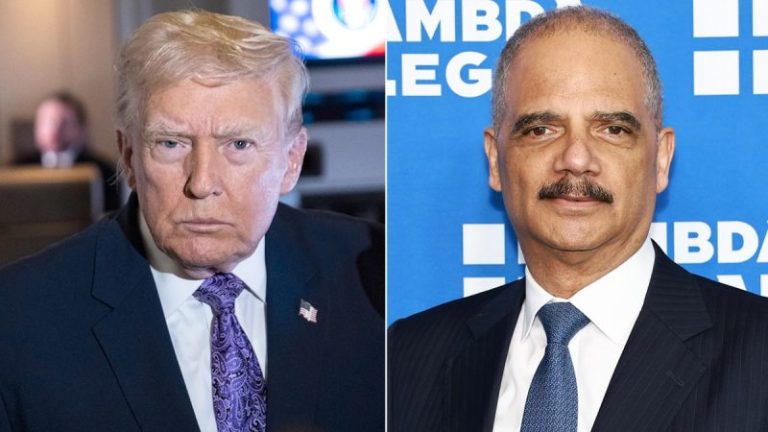
In a Monday Truth Social post, the president shared a video featuring clips of former Attorney General Eric Holder, who opined that if Democrats win a ‘trifecta’ in the 2028 elections, the prospect of expanding the Supreme Court should be under consideration. 

Holder made the comment while speaking with Ben Meiselas, co-founder of MeidasTouch, which posted the video last month.

In the Monday Truth Social post, Trump referred to Holder, who served under Democratic President Barack Obama, as an ‘Obama sycophant’ and said that ‘Eric Holder (known as ‘FAST AND FURIOUS’) just gave a Speech where he emphatically stated, above all else, that Democrats will PACK the Supreme Court of the United States if they get the chance. The word is, he wants 21 Radical Left Activist Judges, not being satisfied with the heretofore 15 that they were seeking.’

Trump suggested that eliminating the filibuster would enable Republicans to win in the 2026 midterm elections and the 2028 White House contest.

‘It will be 21, they will destroy our Constitution, and there’s not a thing that the Republicans can do about it unless we TERMINATE THE FILIBUSTER, which will lead to an easy WIN of the Midterms, and an even easier WIN in the Presidential Election of 2028,’ he asserted.

‘Why would the Republicans even think about giving them this opportunity? The American People don’t want gridlock, they want their Leaders to GET THINGS DONE — TERMINATE THE FILIBUSTER, AND HAVE THE MOST SUCCESSFUL FOUR YEARS IN THE HISTORY OF OUR COUNTRY, BY FAR, WITH NOT EVEN THE HINT OF A SHUTDOWN OF OUR GREAT NATION ON JANUARY 30TH!’ Trump declared in the post.

This post appeared first on FOX NEWS

PARIS — Airbus fleets were returning toward normal operations on Monday after the European plane maker pushed through abrupt software changes faster than expected, as it wrestled with safety headlines long focused on rival Boeing.

Dozens of airlines from Asia to the United States said they had carried out a snap software retrofit ordered by Airbus, and mandated by global regulators, after a vulnerability to solar flares emerged in a recent mid-air incident on a JetBlue A320.

Airbus said on Monday that the vast majority of around 6,000 of its A320-family fleet affected by the safety alert had been modified, with fewer than 100 jets still requiring work.

JetBlue Airbus A320 planes at LaGuardia Airport in New York City.Nicolas Economou / NurPhoto via Getty Images file

But some require a longer process and Colombia’s Avianca continued to halt bookings for dates until December 8.

Sources familiar with the matter said the unprecedented decision to recall about half the A320-family fleet was taken shortly after the possible but unproven link to a drop in altitude on the JetBlue jet emerged late last week.

Shares in Airbus were down 2.1% in early trading in Paris.

Following talks with regulators, Airbus issued its 8-page alert to hundreds of operators on Friday, effectively ordering a temporary grounding by ordering the repair before next flight.

“The thing hit us about 9 p.m. [Jeddah time] and I was back in here about 9:30. I was actually quite surprised how quickly we got through it: there are always complexities,” said Steven Greenway, CEO of Saudi budget carrier Flyadeal.

The instruction was seen as the broadest emergency recall in the company’s history and raised immediate concerns of travel disruption particularly during the busy U.S. Thanksgiving weekend.

The sweeping warning exposed the fact that Airbus does not have full real-time awareness of which software version is used given reporting lags, industry sources said.

At first airlines struggled to gauge the impact since the blanket alert lacked affected jets’ serial numbers. A Finnair passenger said a flight was delayed on the tarmac for checks.

Over 24 hours, engineers zeroed in on individual jets.

Several airlines revised down estimates of the number of jets impacted and time needed for the work, which Airbus initially pegged at three hours per plane.

“It has come down a lot,” an industry source said on Sunday, referring to the overall number of aircraft affected.

The fix involved reverting to an earlier version of software that handles the nose angle. It involves uploading the previous version via a cable from a device called a data loader, which is carried into the cockpit to prevent cyberattacks.

At least one major airline faced delays because it lacked enough data loaders to handle dozens of jets in such a short time, according to an executive speaking privately.

UK’s easyJet and Wizz Air said on Monday they had completed the updates over the weekend without cancelling any flights.

JetBlue said late Sunday it expected to have completed work to return to service 137 of 150 impacted aircraft by Monday and plans to cancel approximately 20 flights for Monday due to the issue.

Questions remain over a subset of generally older A320-family jets that will need a new computer rather than a mere software reset. The number of those involved has been reduced below initial estimates of 1,000, industry sources said.

Industry executives said the weekend furor highlighted changes in the industry’s playbook since the Boeing 737 MAX crisis, in which the U.S. plane maker was heavily criticized over its handling of fatal crashes blamed on a software design error.

It is the first time Airbus has had to deal with global safety attention on such a scale since that crisis. CEO Guillaume Faury publicly apologized in a deliberate shift of tone for an industry beset by lawsuits and conservative public relations. Boeing has also declared itself more open.

“Is Airbus acting with the Boeing MAX crisis in mind? Absolutely — every company in the aviation sector is,” said Ronn Torossian, chairman of New York-based 5W Public Relations.

“Boeing paid the reputational price for hesitation and opacity. Airbus clearly wants to show … a willingness to say, ‘We could have done better.’ That resonates with regulators, customers, and the flying public.”

This post appeared first on NBC NEWS

President Donald Trump on Sunday defended Secretary of War Pete Hegseth over allegations he ordered a second strike on a Venezuelan drug boat, saying he believes Hegseth’s denial and would not have supported a follow-up attack if it happened.

The exchange came during a gaggle aboard Air Force One as reporters pressed Trump on claims that Hegseth authorized a second strike that allegedly killed two wounded men after an earlier attack on a suspected drug-smuggling vessel.

Trump repeatedly said Hegseth denied giving such an order. He added that he was aware of the allegation but stressed that Hegseth told him the claim was untrue and that he accepted that explanation without hesitation.

‘He said he did not say that, and I believe him 100%,’ Trump said.

Reporters asked Trump whether he would have approved a second strike if Hegseth had ordered one, prompting him to again distance himself from the allegation while stressing that he trusted his secretary of war.

Trump said he planned to seek additional information about the reported incident but reiterated that Hegseth assured him nothing improper happened.

‘No, I wouldn’t have wanted that. Not a second strike,’ Trump said.

Still, he praised the wider campaign targeting drug-smuggling boats, saying the strikes had sharply reduced the flow of narcotics into the U.S. by sea in recent months.

Trump argued the vessels posed a deadly threat and framed the operations as necessary to protect Americans, calling the missions lethal but justified.

‘You can see the boats,’ he said. ‘You can see the drugs in the boats and each boat is responsible for killing 25,000 Americans.’

Trump went to Hegseth’s defense after reports from outlets such as The Washington Post and CNN claimed the U.S. military ordered a second strike on a suspected drug vessel in the Caribbean on Sept. 2 after the earlier attack left two survivors.

According to The Washington Post, the commander overseeing that operation told colleagues on a secure conference call that the survivors were legitimate targets because they could still contact other traffickers for help and ordered the second strike to comply with what he said was a directive from Hegseth that everyone must be killed.

‘As usual, the fake news is delivering more fabricated, inflammatory and derogatory reporting to discredit our incredible warriors fighting to protect the homeland,’ Hegseth wrote on X on Friday.

‘As we’ve said from the beginning and in every statement, these highly effective strikes are specifically intended to be ‘lethal, kinetic strikes,’’ Hegseth continued. ‘The declared intent is to stop lethal drugs, destroy narco-boats and kill the narco-terrorists who are poisoning the American people. Every trafficker we kill is affiliated with a Designated Terrorist Organization.’

Fox News Digital’s Greg Norman and Alexandra Koch contributed to this report.

This post appeared first on FOX NEWS

Heliostar Metals Ltd. (TSXV: HSTR,OTC:HSTXF) (OTCQX: HSTXF) (FSE: RGG1) (‘Heliostar’ or the ‘Company’) is pleased to announce that Mr James Perry has succeeded the retiring Mr. Jacques Vaillancourt as Chairman at the Company’s Annual General & Special Meeting (‘AGM’) held on November 26th, 2025.

Heliostar’s new Chairman Mr. James Perry commented, ‘I am excited to join Heliostar at this important inflection point. The Company has built a strong foundation through disciplined operations and strategic acquisitions, and I look forward to working closely with the experienced Board and management team as we advance the next phase of growth. Heliostar has the ingredients to become a leading gold producer in the Americas. I will draw on my experience to help steer the Company’s disciplined growth, reinforce strong governance practices, and create lasting value for our shareholders and host communities.’

Charles Funk, President and & CEO, stated – ‘I once again thank our retiring chair for his long service to Heliostar. I strongly welcome James as our new Chairman at a time of considerable growth. Having worked with James previously at Newcrest Mining, I know his ambition for our Company, his growth mindset and the high regard in which he is held across the industry. We are delighted to attract someone of his caliber as we continue advancing toward our goal of becoming a 500,000 ounce per year producer by the end of this decade.’

Mr. Perry is currently President of Sweetwater Royalties, one of the largest landowners in the United States, majority-owned by Orion Resource Partners following its acquisition of Sweetwater’s extensive land and mineral portfolio from Occidental Petroleum in 2020 for approximately US$1.3 billion. Sweetwater’s vast mineral position extends across more than 4.5 million mineral acres in Wyoming, Utah, Colorado, and Michigan, providing an expansive royalty platform spanning industrial minerals, base metals, and renewable-energy opportunities.

Mr. Perry has over 17 years of global mining and resources experience across Asia, Africa, and the Americas, spanning business development, corporate strategy and governance, legal and permitting, ESG, and operations. He spent a decade at Newcrest Mining – one of the world’s largest gold mining companies headquartered in Australia – serving as Business Development Manager and Corporate Counsel. Newcrest was acquired for approximately US$19 billion by Newmont Mining in 2023. Mr. Perry has extensive international experience managing large and complex transactions, including leading Newcrest’s entry into Ecuador and its investment in Lundin Gold’s world-class Fruta del Norte gold district. He possesses broad expertise in project evaluation and negotiation across diverse sectors and jurisdictions. He is a lawyer and holds an M.Sc. in History and International Relations from the London School of Economics.

Incentive plan issuance

Heliostar further announces that, pursuant to the Company’s Omnibus Equity Incentive Compensation Plan, it has granted 250,000 stock options (‘Options’) at an exercise price of $2.63 and 200,000 restricted share units (each, an ‘RSU’) to directors, officers and consultants of the Company. The Options are exercisable for a period of five years and will vest over the next three years. The RSUs will vest in three equal annual instalments commencing on the first anniversary of the grant date.

About Heliostar Metals Ltd.

Heliostar is a gold mining company with production from operating mines in Mexico. This includes the La Colorada Mine in Sonora and the San Agustin Mine in Durango. The Company also has a strong portfolio of development and exploration stage projects in Mexico and the USA. These include the Ana Paula project in Guerrero, the Cerro del Gallo project in Guanajuato, the San Antonio project in Baja Sur, all in Mexico and the Unga project in Alaska, USA.

For Additional Information Please Contact:

Charles Funk
President and Chief Executive Officer
Heliostar Metals Limited
Email: charles.funk@heliostarmetals.com
Phone: +1 844-753-0045
Rob Grey
Investor Relations Manager
Heliostar Metals Limited
Email: rob.grey@heliostarmetals.com
Phone: +1 844-753-0045


Neither TSX Venture Exchange nor its Regulation Services Provider (as that term is defined in the policies of the TSX Venture Exchange) accepts responsibility for the adequacy or accuracy of this release.

Cautionary Statement Regarding Forward-Looking Information

This news release includes certain ‘Forward-Looking Statements’ within the meaning of the United States Private Securities Litigation Reform Act of 1995 and ‘forward-looking information’ under applicable Canadian securities laws. When used in this news release, the words ‘anticipate’, ‘believe’, ‘estimate’, ‘expect’, ‘target’, ‘plan’, ‘forecast’, ‘may’, ‘would’, ‘could’, ‘schedule’ and similar words or expressions, identify forward-looking statements or information. These forward-looking statements or information relate to, among other things, the Company’s annual production goals.

Forward-looking statements and forward-looking information relating to the terms and completion of the Facility, any future mineral production, liquidity, and future exploration plans are based on management’s reasonable assumptions, estimates, expectations, analyses and opinions, which are based on management’s experience and perception of trends, current conditions and expected developments, and other factors that management believes are relevant and reasonable in the circumstances, but which may prove to be incorrect. Assumptions have been made regarding, among other things, the receipt of necessary approvals, price of metals; no escalation in the severity of public health crises or ongoing military conflicts; costs of exploration and development; the estimated costs of development of exploration projects; and the Company’s ability to operate in a safe and effective manner and its ability to obtain financing on reasonable terms.

These statements reflect the Company’s respective current views with respect to future events and are necessarily based upon a number of other assumptions and estimates that, while considered reasonable by management, are inherently subject to significant business, economic, competitive, political, and social uncertainties and contingencies. Many factors, both known and unknown, could cause actual results, performance, or achievements to be materially different from the results, performance or achievements that are or may be expressed or implied by such forward-looking statements or forward-looking information and the Company has made assumptions and estimates based on or related to many of these factors. Such factors include, without limitation: precious metals price volatility; risks associated with the conduct of the Company’s mining activities in foreign jurisdictions; regulatory, consent or permitting delays; risks relating to reliance on the Company’s management team and outside contractors; risks regarding exploration and mining activities; the Company’s inability to obtain insurance to cover all risks, on a commercially reasonable basis or at all; currency fluctuations; risks regarding the failure to generate sufficient cash flow from operations; risks relating to project financing and equity issuances; risks and unknowns inherent in all mining projects, including the inaccuracy of reserves and resources, metallurgical recoveries and capital and operating costs of such projects; contests over title to properties, particularly title to undeveloped properties; laws and regulations governing the environment, health and safety; the ability of the communities in which the Company operates to manage and cope with the implications of public health crises; the economic and financial implications of public health crises, ongoing military conflicts and general economic factors to the Company; operating or technical difficulties in connection with mining or development activities; employee relations, labour unrest or unavailability; the Company’s interactions with surrounding communities; the Company’s ability to successfully integrate acquired assets; the speculative nature of exploration and development, including the risks of diminishing quantities or grades of reserves; stock market volatility; conflicts of interest among certain directors and officers; lack of liquidity for shareholders of the Company; litigation risk; and the factors identified under the caption ‘Risk Factors’ in the Company’s public disclosure documents. Readers are cautioned against attributing undue certainty to forward-looking statements or forward-looking information. Although the Company has attempted to identify important factors that could cause actual results to differ materially, there may be other factors that cause results not to be anticipated, estimated or intended. The Company does not intend, and does not assume any obligation, to update these forward-looking statements or forward-looking information to reflect changes in assumptions or changes in circumstances or any other events affecting such statements or information, other than as required by applicable law.

To view the source version of this press release, please visit https://www.newsfilecorp.com/release/276385

News Provided by Newsfile via QuoteMedia

This post appeared first on investingnews.com

The Trump administration harshly criticized the United Kingdom over its handling of mass immigration and the long-running rape gang scandal that has victimized white girls across the country.

In a statement posted to X, the U.S. State Department called on its Europe-based diplomats to track the effects of rampant immigration. While the statement zeroed in on the U.K., it also highlighted similar problems in Germany and Sweden.

‘The State Department instructed U.S. embassies to report on the human rights implications and public safety impacts of mass migration,’ the statement read. ‘Officials will also report policies that punish citizens who object to continued mass migration and document crimes and human rights abuses committed by people of a migration background.’

The statement referenced the so-called ‘grooming gangs’ made up of mostly Pakistani men who have victimized young girls for decades, with little action taken by the government.

‘In the United Kingdom, thousands of girls have been victimized in Rotherham, Oxford, and Newcastle by grooming gangs involving migrant men,’ the State Department said. ‘Many girls were left to suffer unspeakable abuse for years before authorities stepped in.’

A day after the statement, GB News reported that U.K. Prime Minister Keir Starmer told reporters at the G20 in South Africa that the national inquiry would ‘leave no stone unturned.’

The State Department’s warning comes weeks after several victims — who were members of the independent inquiry — resigned over what they claimed was a continuation of a cover-up. 

One abuse survivor, Ellie Reynolds, told cable channel GMB that the existence of grooming gangs has been ‘brushed under the carpet’ and that ‘our voices have been silenced.’

She was supported by fellow survivor Fiona Goddard, who was groomed from the age of 14, and said that when she spoke out for help she was dismissed as a ‘child prostitute’ by authorities.

Goddard resigned to protest the cover-up, saying members of the grooming gangs near Bradford were in the ‘vast majority … Pakistani men.’

Successive governments — both Conservative and Labour — have been dealing with the revelations for years that a number of grooming gangs, often consisting mostly of men of South Asian or Pakistani heritage, have sexually exploited girls for decades across the north of England.

Prior to the inquiry, Starmer had commissioned a national audit led by Baroness Louise Casey earlier this year. 

On the hot-button issue of the backgrounds of the criminals, the Casey report stated in part, ‘We found that the ethnicity of perpetrators is shied away from and is still not recorded for two-thirds of perpetrators, so we are unable to provide any accurate assessment from the nationally collected data.’

It continued: ‘Despite the lack of a full picture in the national data sets, there is enough evidence available in local police data in three police force areas which we examined which show disproportionate numbers of men from Asian ethnic backgrounds amongst suspects for group-based child sexual exploitation, as well as in the significant number of perpetrators of Asian ethnicity identified in local reviews and high-profile child sexual exploitation prosecutions across the country, to at least warrant further examination.’

Her audit also identified other perpetrators, including White British, European, African or Middle Eastern individuals.

The results of the audit produced 12 recommendations to the government, which have been implemented, including a national inquiry to ‘direct local investigations and hold institutions to account for past failures.’ 

But the Starmer government has been set back by a failure to appoint a chair for the inquiry, and it has faced resignations as critics have accused the Labour government of covering it up for political reasons.

Alan Mendoza, founder of the Henry Jackson Society, told Fox News Digital that ‘successive governments’ have allowed ‘gangs of largely South Asian Muslims to target white British girls, claiming, ‘the Labour government doesn’t want to be seen as stigmatizing demographics or potentially losing votes.’

‘I hope that the inquiry will focus more specifically on the real issue plaguing the U.K. over the last 20 years,’ Mendoza added.

The point person for the government’s inquiry is Labour member of Parliament Jess Phillips, who has served as the parliamentary undersecretary of state for Safeguarding and Violence Against Women and Girls since July 2024.

However, Phillips is facing heavy scrutiny over how she’s handling the set-up of the inquiry.

Asked in Parliament about the nature of the inquiry and whether it will address the perpetrators’ ethnicity, she vowed to be transparent.

‘There is absolutely no sense that ethnicity will be buried away,’ Phillips said. ‘Every single time that there is an apparently needless delay — even though it took seven months to put in place chairs for both the COVID inquiry and the blood inquiry, and nobody moaned about that — it gets used to say that we want to cover something up. That is the misinformation I am talking about. It will not cover things up. We are taking time to ensure that that can never happen.’

Elon Musk weighed in on the matter in a series of X statements earlier this year, stating that Phillips, was a ‘rape genocide apologist’ and the world was witnessing ‘the worst mass crime against the people of Britain ever.’ 

Philips told the BBC that his comments were ‘disinformation’ and ‘endangering’ her, but said it was nothing compared to what the victims of the abuse had faced. 

Commentators say the challenge for the government now is to find those credible and willing to bring justice and lasting change so it won’t happen again.

Fox News Digital reached out to Phillips’ office but received no response.
 

This post appeared first on FOX NEWS

Silver missed the Black Friday sale memo, rising to a new all-time high of US$56.86 per ounce.

The white metal’s price rise came after CME Group (NASDAQ:CME) halted trading on the Comex on Friday (November 28), citing a ‘cooling issue’ at a CyrusOne data center located in a Chicago suburb.

‘On November 27, our CHI1 facility experienced a chiller plant failure affecting multiple cooling units,’ a CyrusOne spokesperson explained to CNBC in an email. “Our engineering teams, along with specialized mechanical contractors, are on-site working to restore full cooling capacity. We have successfully restarted several chillers at limited capacity and have deployed temporary cooling equipment to supplement our permanent systems.”

A CME Group X post shows that by 5:46 a.m. PST, all markets were open and trading.

According to Reuters, the outage is one of the longest in years for CME Group.

Some traders are taking the disruption as a reminder of the market’s strong reliance on systems that don’t always run perfectly. However, others have pointed out that thinner activity in the US due to Thursday’s (November 27) Thanksgiving holiday likely helped minimize the impact of the stoppage.

‘If there was to be a glitch day, today’s probably a good day to have it,’ Joe Saluzzi, co-manager of trading at Themis Trading in Chatham, New Jersey, told the news outlet.

Silver price chart, November 27 to 28, 2025.

While silver is known for lagging behind gold before outperforming, it’s now ahead of its sister metal in terms of percentage gains — silver is up about 84 percent year-to-date, while gold has risen around 58 percent.

Gold was also on the move on Friday, breaking back above US$4,200 per ounce for the first time since mid-November, but it remains below its all-time high of nearly US$4,400, set in October.

Silver’s breakout this year has been driven by various factors.

As a precious metal, it’s influenced by many of the same factors as gold, but its October price jump, which took it past the US$50 level, was also driven by a lack of liquidity in the London market.

While that issue appears to have resolved, a new situation has recently emerged — Bloomberg reported on Tuesday (November 25) that Chinese silver stockpiles are now at their lowest level in a decade after huge shipments to London.

Tariff concerns and silver’s new status as a critical mineral in the US have also provided support in 2025.

The white metal’s industrial side also shouldn’t be forgotten — according to the Silver Institute, industrial demand for silver reached a record 680.5 million ounces in 2024, driven by usage in grid infrastructure, vehicle electrification and photovoltaics. Total silver demand was down 3 percent year-on-year in 2024, but still exceeded supply for the fourth year in a row, resulting in a deficit of 148.9 million ounces for the year.

Watch five experts share their thoughts on the outlook for silver.

Time will tell what’s next for silver, but some experts see it continuing to outperform gold in 2026.

‘The sure money is made in the gold sector, but the big money is made in the silver sector — that’s proven true over the last couple of precious metals cycles. I believe it will be true in this one as well,’ said Jay Martin of VRIC Media.

Securities Disclosure: I, Charlotte McLeod, hold no direct investment interest in any company mentioned in this article.

This post appeared first on investingnews.com